


Page 69 - October-November-2017
P. 69
68                                                                                                             69

            compatibility with the skin in many circumstances,   in flexible printed electronic devices such as                                                             clothing. These stretchable electronic inks deliver   large areas. The conductive tracks are produced in a
                                                                                                                                                                            stable performance despite repeated elongation.
                                                                                                                                                                                                                              four-step process and one of these can be patterned
            are damaged when washed and are uncomfortable
                                                              transistors and oscillators. Apart from the obvious
 Reports    textiles-based electronics present new possibilities   adhesion and flexibility, the new applications require                                                   circuits have shown them to be washable, durable,   Inkjet printing of graphene-based conductive inks is
                                                                                                                                                                            A third-party evaluation of fabrics that incorporate
                                                                                                                                                                                                                              using an inkjet printer.
            to wear because they are not breathable. Wearable,
                                                              requirements of conductivity, fine line resolution,
                                                                                                                                                                            these DuPont materials to create thin electronic
            for flexible circuits, healthcare and environment
                                                              stretchability, washability and formability, Silver
                                                                                                                                                                            and capable of withstanding up to 100 wash cycles.
                                                                                                                                                                                                                              an encouraging research approach in the field of
            monitoring, energy conversion, and many others.
                                                              nanoparticles (NPs) as inkjet printing inks are the
                                                                                                                                                                            These DuPont materials can be used in many
                                                                                                                                                                                                                              printed electronics as both the benefits of inkjet
            Electronic textiles (e-Textiles) are innovative textile
                                                              most reported and utilised conductive inks because
                                                                                                                                                                                                                              printing and extraordinary electronic, optical and
                                                                                                                                                                            common manufacturing processes to produce smart
            materials, (fabrics, yarns and threads), that
                                                              of their excellent electrical conductivity and strong
                                                                                                                                                                                                                              mechanical properties of graphene can be exploited
                                                                                                                                                                            clothing, including fitness and outerwear, without
                                                              antioxidant characteristics. However higher
            incorporate conductive fibres or elements directly
            in/on to the textile substrate. These materials
                                                              temperatures are required in order to obtain
            eliminate wires and hard electronics, and the
            resultant products are soft and tactile. Current   concentration of NPs and higher sintering                                                                    significant investment.                           and has recently been an active field of research.
                                                              continuous metallic phase, which increase
            technologies include weaving of separate metal    processing cost and limit the choice of substrates to


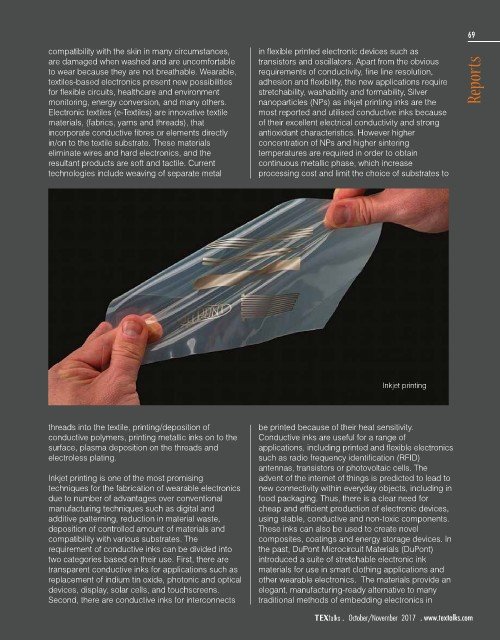
 Inkjet printing


 Printing Prospects                                                                         Inkjet printing


 Conductive inks for e-Textiles  threads into the textile, printing/deposition of   be printed because of their heat sensitivity.


            conductive polymers, printing metallic inks on to the
                                                              applications, including printed and flexible electronics
            surface, plasma deposition on the threads and     Conductive inks are useful for a range of                                                                     Crucially, smart fabrics will require devices to be   Graphene is carbon in the form of single-atom-thick
 Industry data shows that after a decade of advances   development of the printed electronics industry.   electroless plating.  such as radio frequency identification (RFID)   connected, much like with a PCB. National Physics   membranes, and is highly conductive. The
 in digital printing technologies for textile, only 2% of   They’re new and novel, and the business   antennas, transistors or photovoltaic cells. The                      Laboratory UK developed a new method for          graphene-based inks can be applied onto cotton to
 the world’s printed textiles are produced digitally.   opportunities they present are growing exponentially.   Inkjet printing is one of the most promising   advent of the internet of things is predicted to lead to   producing conductive textiles which could end up   produce a conductive textile. The work, published in
 Most of digital printing on textiles is done today   techniques for the fabrication of wearable electronics   new connectivity within everyday objects, including in       turning a fabric into, effectively, a wearable PCB,   the journal Carbon, demonstrates a wearable motion
 mainly on polyester fabrics using dye sublimation.   Recent advances, such as embroidering circuits into   due to number of advantages over conventional   food packaging. Thus, there is a clear need for   connecting all the active parts of the wearable. It can   sensor based on the conductive cotton. The
 e-Textiles or smart garments, smart clothing,   fabric or transparent sensor material that can be   manufacturing techniques such as digital and   cheap and efficient production of electronic devices,   be applied to almost all woven and knitted fabrics.   adhesion of the modified graphene to the cotton
 electronic textiles, smart textiles, or smart fabrics;   printed on to textiles, are helping to create a range of   additive patterning, reduction in material waste,   using stable, conductive and non-toxic components.   This technique could make the integration of   fibre is similar to the way cotton holds coloured dyes,
 have a digital component or electronics embedded   technologies that bring together the clothing,   deposition of controlled amount of materials and   These inks can also be used to create novel   electronics simple and practical by enabling   and allows the fabric to remain conductive after
 within them. While it may still be in its infancy, it is a   technology and textile industries to create fabrics   compatibility with various substrates. The   composites, coatings and energy storage devices. In   lightweight circuits to be printed directly onto   several washes.
 fast-growing market with new capabilities being   with capabilities for users as varied as athletes,   requirement of conductive inks can be divided into   the past, DuPont Microcircuit Materials (DuPont)   complete garments. The methodology binds,
 developed that will enable users to interact with their   patients, soldiers and ordinary consumers. Most of   two categories based on their use. First, there are   introduced a suite of stretchable electronic ink   chemically, a catalyst to the fibre – a nanometal seed   The printing, especially digital printing, of conductive
 surroundings and to communicate data via   the current wearable technologies rely on rigid   transparent conductive inks for applications such as   materials for use in smart clothing applications and   layer, and can be applied at any stage of the   inks on to textile substrate is an active research area
 embedded sensors or conductive yarn through the   electronic components mounted on flexible materials   replacement of indium tin oxide, photonic and optical   other wearable electronics.  The materials provide an   manufacturing process. It is highly conductive,   and has the potential to revolutionise the e-Textiles
 clothes they wear. e-Textiles are impacting the   such as plastic films or textiles. These offer limited   devices, display, solar cells, and touchscreens.   elegant, manufacturing-ready alternative to many   provides excellent flexibility and can be used on   arena and can offer a multitude of opportunities for
                                                                                                                                                                                                                              smart clothing and flexible electronics applications.
            Second, there are conductive inks for interconnects   traditional methods of embedding electronics in
 October/November  2017                                                            October/November  2017

