


Page 77 - TEXtalks October/November 2021
P. 77
77
                              An innovative AP


                  Tester for a variety of


                             textile substrates


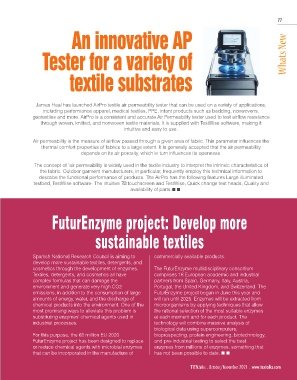
               James Heal has launched AirPro textile air permeability tester that can be used on a variety of applications,
                  including performance apparel, medical textiles, PPE, infant products such as bedding, nonwovens,
              geotextiles and more. AirPro is a consistent and accurate Air Permeability tester used to test airflow resistance
                 through woven, knitted, and nonwoven textile materials. It is supplied with TestWise software, making it
                                                   intuitive and easy to use.

              Air permeability is the measure of airflow passed through a given area of fabric. This parameter influences the
                  thermal comfort properties of fabrics to a large extent. It is generally accepted that the air permeability
                                 depends on its air porosity, which in turn influences its openness.

               The concept of ‘air permeability is widely used in the textile industry to interpret the intrinsic characteristics of
                 the fabric. Outdoor garment manufacturers, in particular, frequently employ this technical information to
                 describe the functional performance of products. The AirPro has the following features Large illuminated
              testbed, TestWise software- The intuitive 7 touchscreen and TestWise, Quick change test heads, Quality and
                                                     availability of parts.


                      FuturEnzyme project: Develop more


                                       sustainable textiles


              Spanish National Research Council is aiming to   commercially available products.
              develop more sustainable textiles, detergents, and
              cosmetics through the development of enzymes.   The FuturEnzyme multidisciplinary consortium
              Textiles, detergents, and cosmetics all have    comprises 16 European academic and industrial
              complex formulas that can damage the            partners from Spain, Germany, Italy, Austria,
              environment and generate very high CO2          Portugal, the United Kingdom, and Switzerland. The
              emissions, in addition to the consumption of large   FuturEnzyme project began in June this year and
              amounts of energy, water, and the discharge of   will run until 2025. Enzymes will be extracted from
              chemical products into the environment. One of the   microorganisms by applying techniques that allow
              most promising ways to alleviate this problem is   the rational selection of the most suitable enzymes
              substituting enzymes' chemical agents used in   at each moment and for each product. The
              industrial processes.                           technology will combine massive analysis of
                                                              biological data using supercomputers,
              For this purpose, the €6 million EU 2020        bioprospecting, protein engineering, biotechnology,
              FuturEnzyme project has been designed to replace   and pre-industrial testing to select the best
              or reduce chemical agents with microbial enzymes   enzymes from millions of enzymes, something that
              that can be incorporated in the manufacture of   has not been possible to date.

                                                                                    October/November 2021

