


Page 102 - TEXtalks International October/November 2022
P. 102
102                                                                                                                                                                                                                            103
                                                                  COMPACTapron                                                                                                         French company


                                                                          The new                                                                                                      introduces the


                                                                       generation                                                                                                      world’s first flax


                                                                     lattice apron                                                                                                     fiber racing


                                                                      compacting                                                                                                       yacht


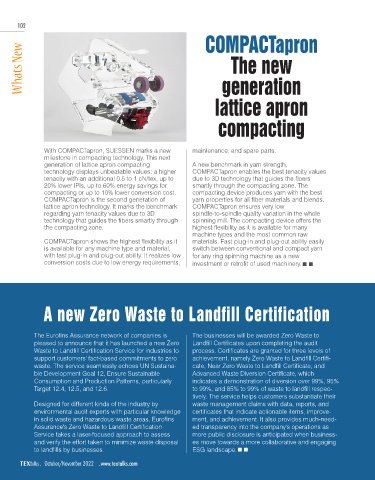
               With COMPACTapron, SUESSEN marks a new         maintenance, and spare parts.                                        Grand Largue Composites (GLC, Mondeville, France)   Class40 is one of the most competitive fleets in yacht
               milestone in compacting technology. This next                                                                       has introduced the world’s first flax fiber composite   racing. The hulls of Class40 yachts must be
               generation of lattice apron compacting         A new benchmark in yarn strength,
               technology displays unbeatable values: a higher   COMPACTapron enables the best tenacity values                     racing yacht. The yacht, called Crosscall, won the   lightweight, strong, stiff, and durable in extreme
               tenacity with an additional 0.5 to 1 cN/tex, up to   due to 3D technology that guides the fibers                    Class40 World Championships in June 2022 and is a   conditions. Furthermore, they cannot be reinforced
               20% lower IPIs, up to 60% energy savings for   smartly through the compacting zone. The                             prototype of the new Lift V2 design by Marc Lombard,   with carbon fibers to keep costs down. Therefore, the
               compacting or up to 10% lower conversion cost.   compacting device produces yarn with the best                      one of the leading naval architects in this field. Flax is   quality and reliability of the resins used for the
               COMPACTapron is the second generation of       yarn properties for all fiber materials and blends.                  two to three times stronger than cotton, making it one   infusion and lamination of the hulls are of key
               lattice apron technology. It marks the benchmark   COMPACTapron ensures very low                                    of the strongest natural fibers.
               regarding yarn tenacity values due to 3D       spindle-to-spindle quality variation in the whole                                                                     importance. To make the design a reality, skilled
               technology that guides the fibers smartly through   spinning mill. The compacting device offers the                 The flax plant species Linum usitatis- simum is made   infusion specialist, GLC, turned to its long-time
               the compacting zone.                           highest flexibility as it is available for many                      into linen fabrics, linseed oil, and linoleum flooring.   material supplier, Sicomin. The hull was molded and
                                                              machine types and the most common raw                                Flax fiber is obtained from the inner bark of the stem   infused in one piece, and the deck — including the
               COMPACTapron shows the highest flexibility as it   materials. Fast plug-in and plug-out ability easily              of a plant grown in temperate and subtropical regions   hybrid flax fiber cockpit was also infused as a single
               is available for any machine type and material,   switch between conventional and compact yarn                                                                       part. The internal structure was then laminated into
               with fast plug-in and plug-out ability. It realizes low   for any ring spinning machine as a new                    of the world. Utilizing flax fibers in technical
               conversion costs due to low energy requirements,   investment or retrofit of used machinery.                        applications fulfills the required characteristics and is   the hull by hand before the hull and deck were finally
                                                                                                                                   good for the environment.                        bonded together.


                                                                                                                                     New Criteria to improve transparency and integrity for organic cotton
               A new Zero Waste to Landfill Certification
                                                                                                                                    The comprehensive and strict requirements of the
                                                                                                                                    Global Organic Textile Standard (GOTS) ensure   unannounced gin audits where there is a high
                                                                                                                                                                                    perception of risk.
            The Eurofins Assurance network of companies is    The businesses will be awarded Zero Waste to                          transparent and traceable processing for organic
            pleased to announce that it has launched a new Zero   Landfill Certificates upon completing the audit                   textiles from field to finished product. GOTS is   These new requirements must be added to the
            Waste to Landfill Certification Service for industries to   process. Certificates are granted for three levels of       significantly raising its requirements for certified gins   numerous checks and balances already performed
            support customers' fact-based commitments to zero   achievement, namely Zero Waste to Landfill Certifi-                 to improve transparency and integrity for organic   throughout every processing stage. Seed cotton
            waste. The service seamlessly echoes UN Sustaina-  cate, Near Zero Waste to Landfill Certificate, and                   cotton. Firstly, a compulsory farm-gin registry for all   entering the GOTS supply chain is tested for the
            ble Development Goal 12, Ensure Sustainable       Advanced Waste Diversion Certificate, which                           farms and farm groups whose certified raw material   presence of genetically modified organisms (GMOs)
            Consumption and Production Patterns, particularly   indicates a demonstration of diversion over 99%, 95%                enters the GOTS system is being introduced,     according to the applicable ISO protocol.
            Target 12.4, 12.5, and 12.6.                      to 99%, and 85% to 99% of waste to landfill respec-                   including information on on-farm yields.        GOTS-approved certification bodies include further
                                                              tively. The service helps customers substantiate their                                                                testing (such as for pesticide residue) and are fully
            Designed for different kinds of the industry by   waste management claims with data, reports, and                       The registry will be implemented progressively,   authorized to reject material that does not meet
            environmental audit experts with particular knowledge   certificates that indicate actionable items, improve-           starting in India. Raw cotton will also not be allowed   requirements. Additionally, before certification
            in solid waste and hazardous waste areas, Eurofins   ment, and achievement. It also provides much-need-                 to travel more than 500km from the farm to the   bodies issue a transaction certificate (TC), GOTS
            Assurance's Zero Waste to Landfill Certification   ed transparency into the company's operations as                     certified gin. The shorter trade chain will protect   requires a thorough assessment, including a
            Service takes a laser-focused approach to assess   more public disclosure is anticipated when business-                 vulnerable points and optimize the process for   plausibility check in the form of volume
            and verify the effort taken to minimize waste disposal   es move towards a more collaborative and engaging              buyers. GOTS also intends to increase its number of   reconciliation.
            to landfills by businesses.                       ESG landscape.
               October/November 2022                                                                                                                                                                      October/November 2022

