


Page 17 - September-October-2020
P. 17
16                                                                                                             17
 World textile chemicals   45 fashion brands


 market to hit $31.3 Billion   promise to be


 worth by 2027    forest protector


             On World Rainforest Day, 45 brands, including
 The global textile chemicals market is projected to   segment, the CAGR for this segment is revised to   Walmart-owned ASDA/George, Ralph Lauren,
 reach a net worth of USD31.3 billion by 2027.   2.7% for the next 7-year period. The US market is   Sainsbury’s, Morrisons, Bestseller, Ivy & Oak, Masai,
 According to an analysis report of the industry, the   estimated at $7.1 billion, while China is forecast to   Fiber X Finland, Nanushka, and Ted Baker—which
 industry, which currently stands at $26.2 billion, will   grow at 4.8% CAGR.  together represent $100 billion in annual
 reach $31 billion by 2027 if growth trends continue   revenue—have launched CanopyStyle policies to
 to grow on their current trajectories.   The Textile Chemicals market in the US alone is   transform the viscose supply chain and protect the
 estimated at $7.1 billion in the year 2020. China is   world’s forests.
 Natural, one of the 5,000 segments analysed in the   projected to reach a market size of $6.2 billion by
 report, is projected to record 2.4% CAGR and reach   2027, trailing a CAGR of 4.8% from 2020 to 2027.   "Their commitments lend significant additional
 $10 billion over the next 7 years. After an early   Other geographic markets are forecast to grow at a   purchasing power to CanopyStyle and the collective
 analysis of the on-going global pandemic, its   slower rate with Japan projected to grow at 0.6%,   effort to catalyse commercial production of Next
 implications on businesses, the economic crisis   Canada at 1.9%, and Germany at approximately   Generation alternatives and eliminate the use of
 caused by it, and the growth in the synthetic   1.2% CAGR, to name a few.  ancient and endangered forests in clothing,"
             CanopyStyle said.

             “George at ASDA is working to ensure we protect the
             world's forests and our collective climate through
 China’s dominance in textile and   committing to only sourcing viscose fibres from
             sustainable sources for all our clothing and home
 apparel sourcing down, but still not out    textile products," said Melanie Wilson, Senior Director
             of Sustainable Sourcing and Quality at George. “We
             are thrilled to be part of the CanopyStyle initiative to
             help save the world’s ancient and endangered forests,
 Although China continues to lead the global   factor is that following the Coronavirus outbreak,   and look forward to collaborating and scaling up the
 sourcing market, the dramatic dominance is   companies shifted their preference from reshor-  implementation of innovative solutions for textile
 lesser than previous years, a new survey by   ing to near-shoring.  sourcing.”
 Hong Kong-based supply chain compliance
 solutions provider QIMA has found.  The consistent regional competitor for China is   Keeping forests standing is crucial to minimizing the
 Vietnam, with 40% of European participants   likelihood of future pandemics, and meeting critical
 According to the survey 55% of respondents   grading Vietnam as their top sourcing region.   climate and biodiversity targets set by the world’s
 reported Chinese suppliers accounted for over   Following closely are India and Bangladesh.   scientists. Today’s commitments will reduce the
 half of their buying volumes in the first half of   Taiwan too enjoyed overwhelming support as a   growing pressure on forests for viscose sourcing, and
 2020. The report, ‘Evolution of Global Sourcing in   top sourcing region for US-based companies. In   will speed the implementation of Next Generation
 2020,’ analyses the changes in the global supply   the strain of near-sourcing, US-based compa-  Solutions, such as making viscose from recycled
 nies are increasingly opting for Latin and South
 chains in the wake of the Covid-19 pandemic,   American sourcing destinations. Meanwhile,   textiles or microbial cellulose grown on food waste.
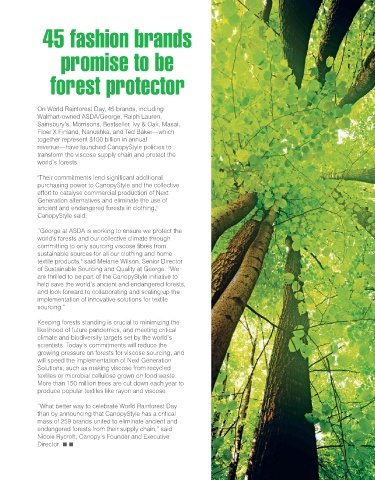
 drawing on input from more than 200 businesses   European companies are increasingly opting for   More than 150 million trees are cut down each year to
 across a variety of consumer products.  Turkey as their sourcing destination of choice   produce popular textiles like rayon and viscose.
 with 30% of respondents placing Turkey in the
 The trend was most noticeable in textiles,   top three sourcing destinations of preference.  “What better way to celebrate World Rainforest Day
 footwear, and apparel businesses. Respondents   than by announcing that CanopyStyle has a critical
 with more than 50% sourcing from China   US-based businesses are most likely to diversify   mass of 259 brands united to eliminate ancient and
 dropped from 72% in the first half of 2019 to 46%   sourcing, with 95% US respondents hinting at   endangered forests from their supply chain,” said
 in the corresponding time frame this year. One   such patterns of thought.  Nicole Rycroft, Canopy’s Founder and Executive
             Director.

 September/October 2020                                                             August/September 2020

