


Page 36 - TEXtalks. September-October 2022
P. 36
36 37
Panel Discussions-Highlights • Iqbal Khurram. CEO. YS Group-Nishat Chunnian.
Panel discussions are one of the prominent and Pakistan
unique features of ICC 2022. These panelists are • Khalid Abdullah. Cotton Commissioner.
finalized owing to their expertise and excellence in Government of Pakistan
their domain so that the discussions could be fruitful • Dr Shafique Ahmed. Regional Director. Better
and inspiring for the audience. This year, ICC 2022 Cotton Initiative
had four-panel discussions with different themes. • Dr Masood Arshad. WWF. Pakistan
• Bilal Israel Khan. Executive Director. FAP.
Panel: Local Cotton Challenges and the Possible (Progressive Farmer)
Solutions • Khawaja Tahir Mahmood. CEO - Country Head.
Apart from facing the global issues discussed in the Control Union Pakistan (Pvt) Ltd.
Stephanie Thiers. Director, European Brands, and Retailers. CCI, USA Saleha Asif. CEO. Pakistan Textile Council first panel, Pakistan is facing even hard challenges Panel: Cotton Quality, Challenges, and Remediation • Carl Pe
for the local cotton crop. That is why the Pakistan's cotton production has shrunk by 19% in Ahead 2022 United Kin
second-panel discussion focused on Pakistani cotton the current season, mainly due to the devastation The cotton crop year 2021-22 has seen dramatic • Jeff Elder
and featured all stakeholders, from farmers to textile caused by heavy rainfall and flash floods nationwide. crop damage globally due to climate change, Allbright
manufacturers. For this panel discussion followings The profitability of other crops has also forced cotton droughts, and floods. For this panel discussion, the • Carlo
were the group participants: growers to shift to them. following were the group participants: Calcot Ltd
• Kamran Arshad. Director. • Mazhar Hus
Ghazi Fabrics. Pakistan Cotton Cou
Mazhar Mirza. Pakistan Representative. Cotton Council International
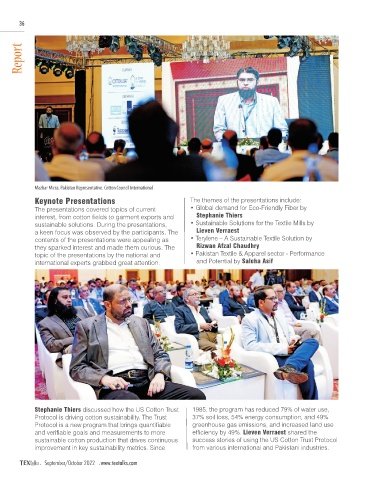
Keynote Presentations The themes of the presentations include:
The presentations covered topics of current • Global demand for Eco-Friendly Fiber by
interest, from cotton fields to garment exports and Stephanie Thiers Rizwan Afzal Chaudhry. Commercial Head - Polyester Business, ICI Pakistan Ltd Lieven Verraest. International Textile Technology Consultant
sustainable solutions. During the presentations, • Sustainable Solutions for the Textile Mills by
a keen focus was observed by the participants. The Lieven Verraest
contents of the presentations were appealing as • Terylene – A Sustainable Textile Solution by
they sparked interest and made them curious. The Rizwan Afzal Chaudhry
topic of the presentations by the national and • Pakistan Textile & Apparel sector - Performance
international experts grabbed great attention. and Potential by Saleha Asif
The Cotton USA Solutions Team has achieved huge product, ICI collects the discarded PET bottles, and for
TM
success regarding cost savings, productivity increase, each kilogram of Terylene fibers, about 30 PET bottles
and optimization of yarn quality from blown room to are recycled. Through products such as Terylene
ring frames. Over past the five years, the team has Black, ICI Pakistan Ltd continues to play a vital part in
successfully performed more than two hundred 1:1 Mill the growth of the local sustainable textile industry.
Consults and contributed to costs savings and quality
improvement of the licensees or USCTP members. Saleha Asif discussed the performance and potential
of Pakistan’s textile & Apparel sector. In the fiscal year
Rizwan Afzal Chaudhry highlighted the importance of 2018-19, Pakistan’s textile exports were at 13.3 Bn
recycling polyester - ICI’s sustainable solution called USD and reached 19.3 Bn USD in 2021-22 with a
“Terylene.” He discussed how polyester clothing CAGR of 13.2%, indicating exceptional performance.
Stephanie Thiers discussed how the US Cotton Trust 1985, the program has reduced 79% of water use, produces huge amounts of waste and pollutes the air, During COVID-19, Pakistan’s exports enjoyed a 45%
Protocol is driving cotton sustainability. The Trust 37% soil loss, 54% energy consumption, and 49% soil, and water with plastic microfibers and hazardous growth outperforming its neighbors India, Vietnam, and
Protocol is a new program that brings quantifiable greenhouse gas emissions, and increased land use chemicals. The Terylene clean fibers have been Bangladesh with 16%, 6%, and 26% growth. She also
and verifiable goals and measurements to more efficiency by 49%. Lieven Verraest shared the produced from 40% PET Flakes and 60% Virgin highlighted that Pakistan strongly needs to diversify its
sustainable cotton production that drives continuous success stories of using the US Cotton Trust Protocol polymer along with MEG through glycolysis. For this products and market to survive and expand.
improvement in key sustainability metrics. Since from various international and Pakistani industries.
September/October 2022 September/October 2022

