


Page 60 - TEXtalks. September-October 2022
P. 60
60


                            0.1 % BEZAKTIV ZERO Orange GO               2.8 % CI Reactive Yellow 145
                            1.8 % BEZAKTIV ZERO Scarlet GO              3.5 % CI Reactive Red 195
                            0.1 % BEZAKTIV ZERO Navy GO                 0.2 % CI Reactive Blue 221
                            2.0 % reactive dyes                         6.5 % reactive dyes
                            40 g/l Glauber's salt                       90 g/l Glauber's salt
                            5 g/l soda ash                              5 g/l soda ash
                            2.5 ml/l NaOH 38 °Bé                        3.5 ml/l NaOH 38 °Bé
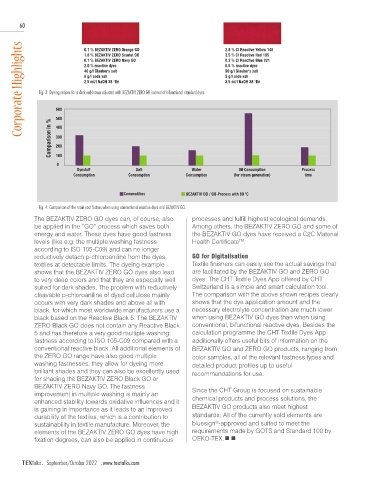
             Fig. 3: Dyeing recipes for a dark red-brown adjusted with BEZAKTIV ZERO GO instead of bifunctional standard dyes.

                   600
                   500
                 Comparison in %  300
                   400

                   200
                   100
                   0
                         Dyestuff           Salt             Water          Oil Consumption     Process
                        Consumption       Consumption       Consumption    (for steam generation)  time


                                        Commodities         BEZAKTIV GO / GO-Process with 60 °C
             Fig. 4: Comparison of the main cost factors when using conventional reactive dyes and BEZAKTIV GO.
            The BEZAKTIV ZERO GO dyes can, of course, also    processes and fulfill highest ecological demands.
            be applied in the “GO” process which saves both   Among others, the BEZAKTIV ZERO GO and some of
            energy and water. These dyes have good fastness   the BEZAKTIV GO dyes have received a C2C Material
            levels (like e.g. the multiple washing fastness   Health Certificate .
                                                                            TM
            according to ISO 105-C09) and can no longer
            reductively detach p-chloroaniline from the dyes   GO for Digitalisation
            textiles at detectable limits. The dyeing example   Textile finishers can easily see the actual savings that
            shows that the BEZAKTIV ZERO GO dyes also lead    are facilitated by the BEZAKTIV GO and ZERO GO
            to very deep colors and that they are especially well   dyes: The CHT Textile Dyes App offered by CHT
            suited for dark shades. The problem with reductively   Switzerland is a simple and smart calculation tool.
            cleavable p-chloroaniline of dyed cellulose mainly   The comparison with the above shown recipes clearly
 °C, the dyeing process with BEZAKTIV GO is   textile using a washing process with a low water and   occurs with very dark shades and above all with   shows that the dye application amount and the
 generally shorter, which also increases the   energy consumption.  black, for which most worldwide manufacturers use a   necessary electrolyte concentration are much lower
 productivity for the textile finisher. Savings in the   black based on the Reactive Black 5. The BEZAKTIV   when using BEZAKTIV GO dyes than when using
 required salt quantity can be simultaneously   Even for dyeings in the cold pad batch process the   ZERO Black GO does not contain any Reactive Black   conventional, bifunctional reactive dyes. Besides the
 achieved. The unnecessary salt and the resulting   rather high fixation speed allows for shorter dwelling   5 and has therefore a very good multiple washing   calculation programme the CHT Textile Dyes App
 Many industrial sectors all over the world show a   can be observed. The dye properties themselves are   lower electrolyte concentration in the dyebath not   times. The good wash-off properties lead to savings   fastness according to ISO 105-C09 compared with a   additionally offers useful bits of information on the
 clear trend to sustainability and a conscientious   decisive for a successful use of reactive dyes in such   only allow for significant cost savings in the recipe   in continuous washing processes, specially with dark   conventional reactive black. All additional elements of   BEZAKTIV GO and ZERO GO products, ranging from
 handling of resources. The textile industry is not   processes: They must have a sufficiently high fixation   but also for an improved washing off process of   shades or black.  the ZERO GO range have also good multiple   color samples, all of the relevant fastness types and
 exempted from this trend. Furthermore, the   speed, a very good ease of removal of hydrolysates   unfixed shares after the dyeing. The dyeing of   washing fastnesses, they allow for dyeing more   detailed product profiles up to useful
 worldwide consumption of cotton is increasing, which   and an excellent solubility. Moreover, reactive dyes   medium to dark shades where in classic procedures   p-Chloroaniline-free dyeing with BEZAKTIV ZERO GO  brilliant shades and they can also be excellently used
 can lead to tensions in the area of water availability,   are expected to reach high overall fastness levels,   quite a big share of unfixed dye must be washed off   ZERO refers to the content of undesired arylamines   for shading the BEZAKTIV ZERO Black GO or   recommendations for use.
 land for agriculture and the use of agrochemicals.  especially a good stability towards multiple washing   reveals the benefits of the “GO” process in particular.   (as e.g. p-chloroaniline) which are not detectable in   BEZAKTIV ZERO Navy GO. The fastness
 and also light fastnesses, which allows a generally   With the combination of a very high fixation degree   these dyes.  improvement in multiple washing is mainly an   Since the CHT Group is focused on sustainable
 Consequently, circular economy approaches, and an   longer use of colored textiles, and to lead to   and an excellent ease of removal of hydrolysates, the   enhanced stability towards oxidative influences and it   chemical products and process solutions, the
 improved recycling of used textiles gain in   reproducible, levelled dyeing results without causing   BEZAKTIV GO range allows for a very efficient rinsing   Both dyeing results are free from reductively   is gaining in importance as it leads to an improved   BEZAKTIV GO products also meet highest
 importance. However, the reactive dyeing of   problems. Last but not least due to a good color   and soaping process between 40 and 60°C. An   detachable arylamines and have good multiple   durability of the textiles, which is a contribution to   standards: All of the currently sold elements are
 cellulosic fibres like cotton and its blends is still being   build-up they must also be efficiently applicable for   additional positive effect is achieved by adding only   washing fastnesses and a comparable fastness level.   sustainability in textile manufacture. Moreover, the   bluesign -approved and suited to meet the
                                                                     ®
 effected with water-based processes. In this field,   dark shades.  low concentrations of the CHT auxiliary COTOBLANC   The variant with BEZAKTIV ZERO  GO, however, requires   elements of the BEZAKTIV ZERO GO dyes have high   requirements made by GOTS and Standard 100 by
 too, a tendency towards cold pad batch processes   SEL in the second soaping bath. As a result,   significantly lower dye and salt amounts and additionally   fixation degrees, can also be applied in continuous   OEKO-TEX.
 or exhaust processes with short liquor ratios and   Sustainable and economical dyeing   excellent wet fastness levels can be achieved on the   helps save energy and water - see next page for details.
 lower temperatures of the dyeing and rinsing baths   Compared with a conventional reactive dyeing at 60
                September/October 2022

