

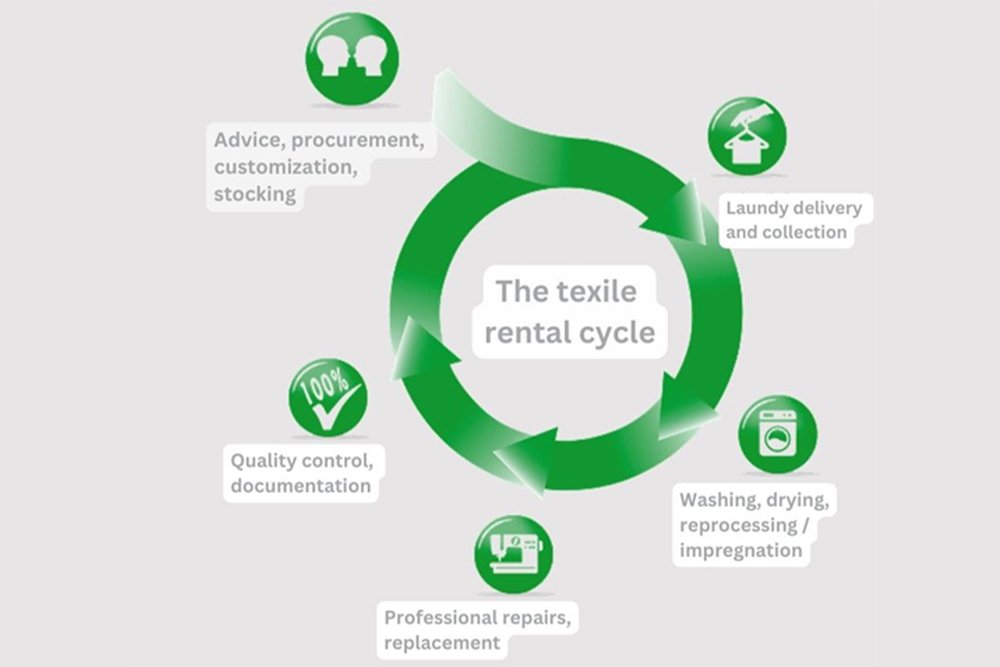
The professional rental service for linen and workwear is a textbook example of a circular, sustainable business model, which uses hard-wearing textiles instead of lower-quality or disposable products (reduce), optimises their useful life through professional care / repairs (reuse) and develops solutions to re-purpose them after they have reached the end of their useful life (recycle).
With its ‘Green Deal’, the European Commission has, inter alia, initiated the transformation of the garment-manufacturing industry from a business model of short-lived consumption to a more sustainable, circular system. By 2030, fast fashion will be replaced increasingly by textile products that have a longer life cycle and thus contribute to reducing environmental pollution.
To achieve this goal, textiles must be more durable, reusable, repairable, fibre-to-fibre recyclable and have a greater proportion of recycled fibres. For the textile-service sector, the circularity requirements defined in Brussels have long been standard practice because hiring out professional workwear and protective clothing, as well as hotel and hospital linen, mop covers and other items, requires precisely these characteristics, i.
e., the fabrics must be durable, washable – and therefore reusable – and easy to repair. Thanks to these qualities, rental linen can remain in the service cycle for a long time and has thus become established as a sustainable alternative to outright purchasing.
The recycling benefits of textile rental services
Besides the two main requirements of ‘reuse’ and ‘repair’, the sector is also working hard on the recycling of old textiles, as called for by the EU textile strategy. Several workwear manufacturers have developed their own returns models, whereby customers can hand back their old workwear when buying new items. The old workwear is then reused or recycled by partner organisations. Large companies, including Deutsche Telekom and Ikea, have also introduced a centralised returns and recycling system for discarded workwear. Indeed, the furniture giant has even created its own home textiles line using old workwear. However, the easiest way to implement a system of this kind is to use a rental service, as the goods are always returned to the specialist company and sorted there. In other words, the used laundry is collected in one place after washing, where it forms a large volume of similar discarded textiles, which greatly simplifies both the collection logistics and the recycling process. These favourable conditions have already led to the establishment of an initial initiative in which several textile service companies pool their waste hotel linen and channel it into industrial cotton-to-pulp recycling.
Whether individual or joint initiatives, this is a testament to the industry’s commitment to the development of solutions for ‘waste materials’.
Textile upcycling for designer items
Solutions for rejected textiles are more varied than simply recycling them. For example, Sweden’s Fristads company offers a repair service for its workwear. The British department store chain John Lewis goes one step further. In a field trial, customers can hand in their garments to selected stores for cleaning and repair. The garments are processed by Johnsons, a laundry and dry-cleaning chain belonging to the Timpson Group. Designers have also recognised second-life opportunities for discarded workwear and contract textiles. For example, they apply elaborate decorations to items from their collections or take them apart and reassemble them. The creatively enhanced goods are then returned to the market as designer items. There are also recycling solutions for large contract textiles, which are converted into bags or cosmetic accessories or, after a colour-changing process, into small batches of aprons. However, the effect of such concepts on reducing textile waste is as small as their diversity. Only the established second-hand model is able to return larger quantities to the economic cycle.
The pros and cons of recycled materials
While the textile-care industry is unanimous in its support for the requirements of the EU textile strategy and is contributing solutions, it disagrees on increasing the proportion of recycled fibres in its products. Although there are already numerous workwear collections and hotel-linen ranges that meet the requirements from Brussels, some of the products do not, however, meet the durability requirements because the fibre quality deteriorates with each recycling stage.
Therefore, many contract-textile manufacturers still rely exclusively on virgin, brand-new fibre materials to ensure durability in industrial laundering.
Texcare International offers the industry the perfect setting to discuss this conflict of objectives in depth.

