

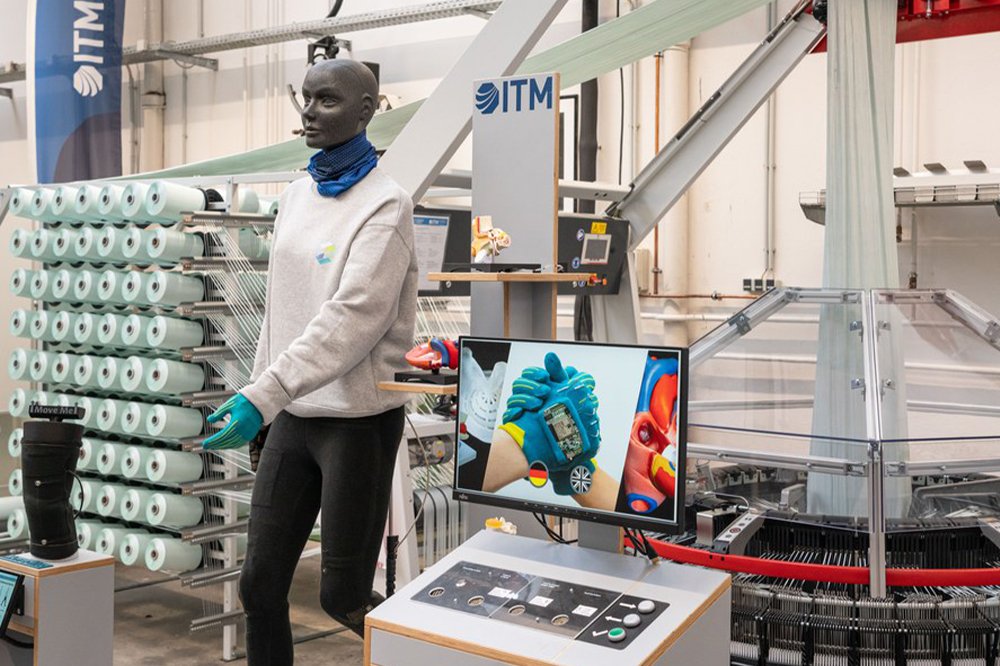
The institute’s 2026 showcase in Frankfurt underlines how textile innovation is increasingly being built at the intersection of fibres, machinery, digital modelling and industrial application.
The Institute of Textile Machinery and High Performance Material Technology (ITM) at TU Dresden will use Techtextil 2026 to present a broad research portfolio aimed at translating textile science into industrial solutions across construction, lightweight engineering, medical technology and sustainable production.
What makes the ITM presentation notable is its full-process-chain approach. TU Dresden says the institute works across material design, machinery development, process engineering and product realization, combining fibers such as carbon, glass, aramid, steel and ceramics into multi-material textile structures tailored for specific applications. The work includes integrating sensors and actuators into textile surfaces and three-dimensional structures, pushing textiles further into functional engineering territory rather than treating them as passive materials alone.
From carbon concrete to tissue engineering
The application range is unusually wide. TU Dresden highlights research in interactive fiber composites, reinforcement textiles, textile architecture, medical textiles and biotechnical structures, including preforming technologies for carbon concrete and fiber-based solutions for implants and tissue engineering. Recycling technologies for high-performance textile materials also form part of the institute’s fair agenda, reflecting the industry’s growing focus on circularity even in technically demanding materials.
AI and simulation move closer to production
A second strategic theme is digitalization. The institute says it is using AI-supported modelling and simulation to analyse structures and processes along the textile value chain and optimize them using data. That work feeds into development of hybrid yarns, 2D and 3D reinforcement structures, programmable 4D semi-finished products, and machine concepts designed for direct industrial integration. Messe Frankfurt’s exhibitor profile similarly positions ITM around simulation-driven, digitally networked process chains and innovative machine concepts.
For the industry, the significance is practical. ITM is not presenting isolated research projects, but a systems view of textile engineering in which advanced materials, automation and application design increasingly have to move together.

