

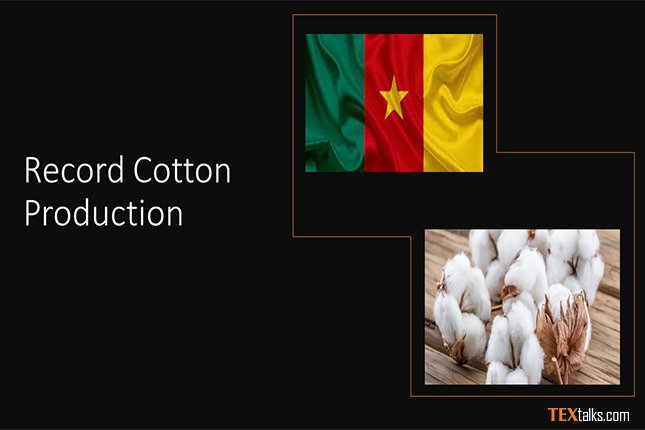
Cameroon, the Central African country, is expected to witness a new record of cotton production aiming at 350,000 tons, according to the country’s cotton development corporation Sodecoton. Cameroon’s cotton production was 328,000 tons in the previous season, mainly exported to various countries, including Asian countries, with China being the leading destination. Other Asian countries importing Cameroon cotton are Bangladesh, Vietnam, and Indonesia.
Last year, as part of its 2020-30 National Development Strategy, the Cameroon government merged Sodecoton and Cotonnière Industrielle du Cameroun (Cicam) to boost its cotton textiles industry. Before the merger, Sodecoton organized the production and marketing of cotton in Cameroon, while Cicam specialized in manufacturing 100 percent cotton loincloths and towels.
In 2019, 18.4 percent of Cameroon’s cotton production was exported to China (compared to 22 percent in 2018), followed by 12.2 percent to Italy and 11 percent to India. Sodecoton is planning to increase the country’s annual cotton production to 600,000 tons by 2025. Sodecoton plans to develop high-yielding seed varieties to reach the ambitious target, instead of the earlier planned introduction of genetically modified (GM) crops.
Cotton production began in Cameroon in the early 1950s, at the end of the colonial era. Under the control of CFDT, a French parastatal was created a decade earlier to supply the French textile industry with fiber. The primary textile manufacturer is CICAM, a local firm producing printed and traditional batik garments. CICAM represents more than 90 percent of the domestic cotton-based manufacturing activity. Other cotton is exported that contributes to the country’s GDP.
Cameroon, the Central African country, is expected to witness a new record of cotton production aiming at 350,000 tons, according to the country’s cotton development corporation Sodecoton. Cameroon’s cotton production was 328,000 tons in the previous season, mainly exported to various countries, including Asian countries, with China being the leading destination. Other Asian countries importing Cameroon cotton are Bangladesh, Vietnam, and Indonesia.
Last year, as part of its 2020-30 National Development Strategy, the Cameroon government merged Sodecoton and Cotonnière Industrielle du Cameroun (Cicam) to boost its cotton textiles industry. Before the merger, Sodecoton organized the production and marketing of cotton in Cameroon, while Cicam specialized in manufacturing 100 percent cotton loincloths and towels.
In 2019, 18.4 percent of Cameroon’s cotton production was exported to China (compared to 22 percent in 2018), followed by 12.2 percent to Italy and 11 percent to India. Sodecoton is planning to increase the country’s annual cotton production to 600,000 tons by 2025. Sodecoton plans to develop high-yielding seed varieties to reach the ambitious target, instead of the earlier planned introduction of genetically modified (GM) crops.
Cotton production began in Cameroon in the early 1950s, at the end of the colonial era. Under the control of CFDT, a French parastatal was created a decade earlier to supply the French textile industry with fiber. The primary textile manufacturer is CICAM, a local firm producing printed and traditional batik garments. CICAM represents more than 90 percent of the domestic cotton-based manufacturing activity. Other cotton is exported that contributes to the country’s GDP.
