

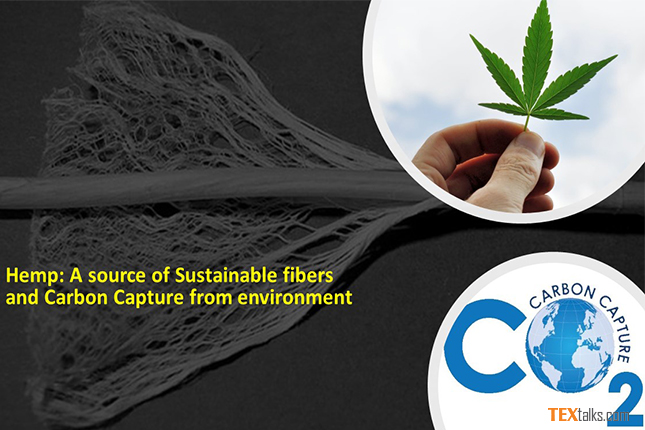
Hemp, or industrial hemp, is a variety of the Cannabis sativa plant but contains low levels of the psychoactive compound tetrahydrocannabinol (THC) compared to marijuana, which is another variety. Hemp is one of the strongest available natural fibers for textile processing.
It is significantly more substantial and durable than cotton and provides better ultraviolet (UV) protection than other natural fiber-based fabrics. Hemp also checks off virtually all of the boxes required to be considered sustainable. It has now been used extensively for various textile articles, including denim fabrics.
The cultivation of hemp could be more beneficial than other plants and trees. Apart from providing the fibers for the textile sector, it could be used to capture carbon dioxide from the atmosphere.
Darshil Shah, Cambridge University Researcher, said that hemp could capture atmospheric carbon twice as effectively as forests while providing carbon-negative biomaterials for architects and designers. Shah pointed out that in contrast to conventional agriculture, which emits large amounts of carbon, hemp farms do the opposite.
Shah is working with the farm to develop new carbon-negative materials that could be used in manufacturing and construction.
He also said, “Industrial hemp absorbs between 8 to 15 tonnes of CO2 per hectare of cultivation. In comparison, forests typically capture 2 to 6 tonnes of CO2 per hectare per year depending on the number of years of growth, the climatic region, the type of trees.”
