

SSM Textile Machinery, Wädenswil (Switzerland) is a subsidiary of the Rieter Group based in Winterthur (Switzerland). In the combined 300-year-old tradition of the Schärer, Schweiter and Mettler companies, which merged in 1989 to become SSM, the commitment to textile machinery and facilities for yarn processing has always been exceptional.
In the past, items of clothing such as jeans were produced purely from cotton. Some time ago now, elastic woven fabrics became established in the clothing industry thanks to their positive characteristics. To produce these elastic yarns, so-called corespun yarns with a dual core that are spun on a ring spinning machine are used for weft threads and sometimes also warp threads.
Due to the increased demand for elastic yarns, traditional ring spinning mills are upgrading their machines to compete in this market.
Corespun yarns that are used to produce woven stretch fabrics consist of an elastic core with a second spinnable fiber wrapped around its entire length. The core can only be made from elastane. Or alternatively, it is made from an elastane yarn and a textured filament yarn. This is known as a “dual-core yarn”. Today, there is even a trend for making the core from two elastane yarns with different drafts and yarn counts together with a textured filament yarn. These “triple-core yarns” further improve the characteristics of these woven stretch fabrics in terms of their stretch and shape-retaining characteristics.
Two production possibilities
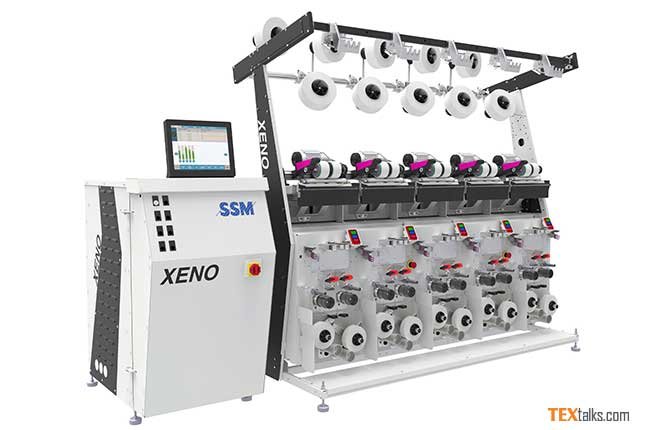
There are essentially two methods of producing corespun yarns with a dual or triple core. In the first method, the elastane yarn and textured filament yarn are spun directly on a Rieter ring spinning machine with the spinnable fibers that act as sheathing. In the second method, the elastane yarn and textured filament yarn are doubled, air-covered and wound up together on a XENO-AC TWIN machine (Fig. 1) before being processed on the ring spinning machine. In a second step, cotton is spun over the dual- or triple-core yarn located on the “cheese packages”, for example using a Rieter ring spinning machine. Both methods require specialized superstructural parts to be fitted on existing ring spinning machines.
For the direct method in which the dual- or triple-core yarn is not pre-wound, these superstructural parts are very tall.
In order to reload the ring spinning machine, it must be switched off. This causes a productivity loss of around 13% in comparison to the indirect method. Furthermore, the operating personnel have to climb onto the ring spinning machine in order to place the bobbins with the textured filament.
Excellent entry opportunity for traditional ring spinners
Corespun yarns with a dual or triple core where the filament has already been doubled and air-covered on an air covering machine are therefore of a higher quality than corespun yarns produced directly on a ring spinning machine.
The method with the XENO-AC TWIN offers traditional ring spinners an excellent opportunity to enter the elastic corespun yarn market and achieve success.
This method is also very user-friendly and safe.
No compromises on yarn quality have to be made.
