

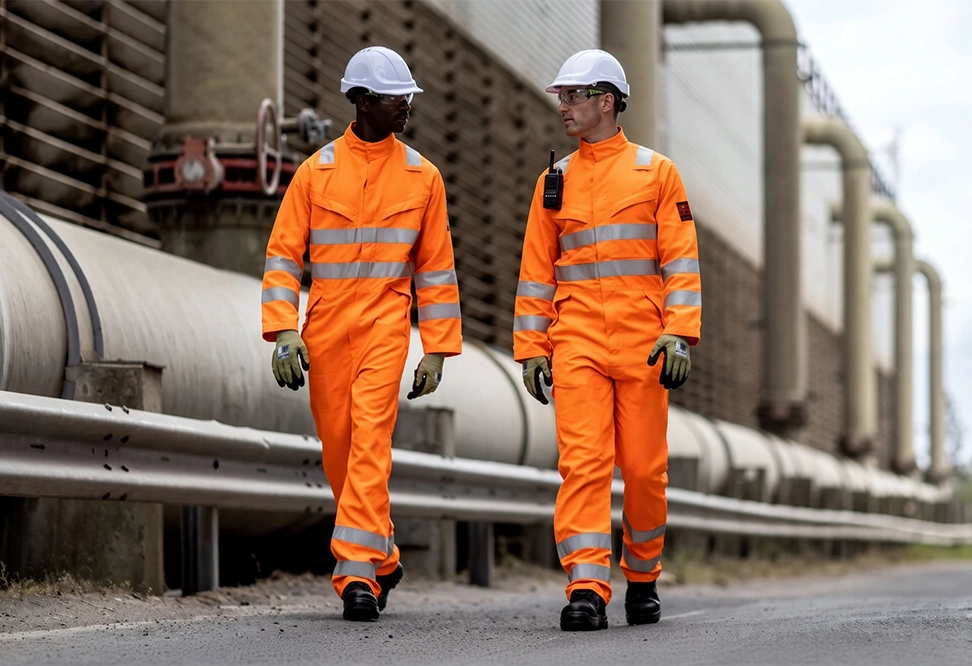
Safety regulation, industrial expansion and demand for better-fitting protective clothing are supporting steady growth, while suppliers increasingly compete on performance, comfort and compliance rather than price alone.
The global industrial workwear market is forecast to expand from $19.38 billion in 2025 to $24.66 billion by 2030, representing a compound annual growth rate of 4.93%, according to Mordor Intelligence. A separate Grand View Research study places the broader workwear market at $20 billion in 2026 and forecasts $28.1 billion by 2033, also implying annual growth of about 4.9%.
Protective clothing dominates demand
Protective workwear accounted for 64.86% of market revenue in 2024, reflecting demand for flame-resistant, high-visibility, chemical-resistant and other garments used in hazardous industrial environments. Manufacturing was the largest end-user sector with a 28.18% share.
Asia-Pacific represented 39.68% of global industrial workwear sales, supported by its large manufacturing base and continued infrastructure investment. Mordor expects the Middle East and Africa to grow fastest, at 6.24% annually through 2030, as construction, energy and industrial projects expand.
Fit becomes a regulatory issue
One emerging growth area is workwear designed for a wider range of body types. Men represented 78.48% of industrial-workwear demand in 2024, but Mordor expects women’s products to grow at 5.83% annually through 2030.
Regulation is reinforcing this shift. From January 13, 2025, US OSHA rules explicitly require construction employers to provide PPE that properly fits each affected worker. Poorly fitting protective clothing can compromise protection and discourage correct use.
Suppliers move towards technical value
Workwear is consequently becoming a more demanding textile category. Buyers increasingly require durability alongside moisture management, flame resistance, visibility, anti-static performance and ergonomic construction. Sustainability is also entering procurement through longer garment life, recycled materials and repair-oriented programmes.
For textile and garment exporters, the opportunity lies in certified, application-specific products rather than commodity uniforms. Mills able to combine protective functionality with comfort, inclusive sizing, traceable materials and recognised testing standards should be better positioned to capture higher-value industrial programmes.
The Mordor forecast should be treated as directional: its publicly available page was last updated in August 2025, and detailed forecasting assumptions are proprietary.
