

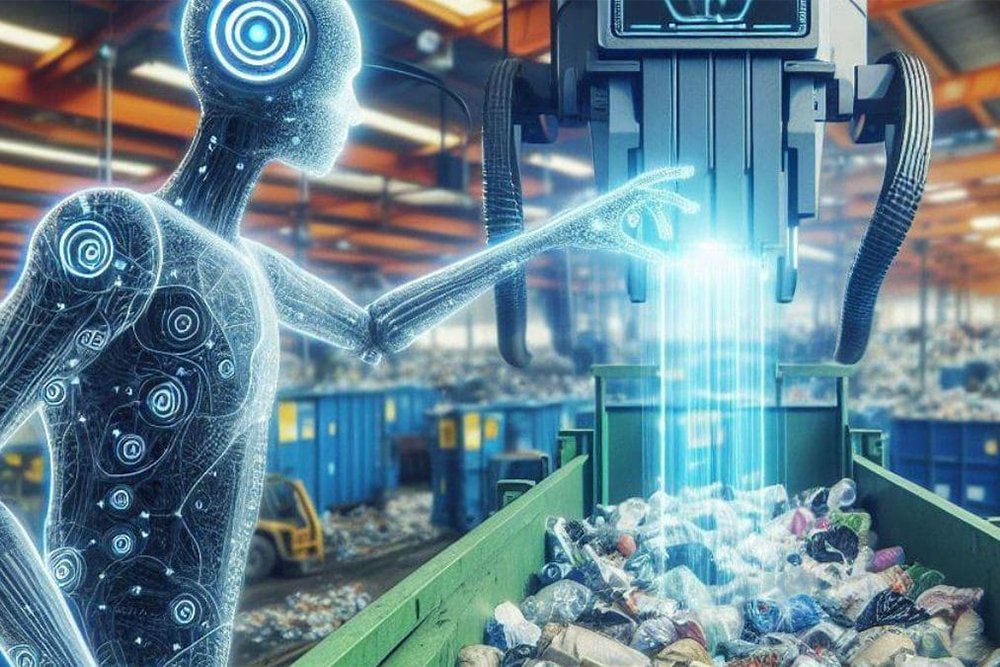
Smart sorting technologies are turning textile waste from a liability into an industrial feedstock—reshaping circularity economics worldwide.
Artificial intelligence is rapidly transforming textile recycling, shifting the industry from labour-intensive sorting to data-driven, high-precision material recovery. According to Grand View Research, the global textile recycling market was valued at USD 4.85 billion in 2024 and is expected to reach USD 6.94 billion by 2033, growing at a CAGR of 4.2%. Europe currently leads, while Asia—especially India—shows strong growth potential.
Across Europe, AI-powered systems combining machine learning, near-infrared (NIR) spectroscopy, hyperspectral imaging and robotics are redefining efficiency. Denmark’s NewRetex already processes 200 tonnes of textile waste monthly and targets 40,000 tonnes annually by 2025. Germany’s CRTX.ai, Sweden’s FAIR project, and Norway’s TOMRA are enabling fibre-level identification of cotton, polyester and wool—critical for fibre-to-fibre recycling. Commercial systems now achieve accuracy rates of up to 99%, cut sorting costs by nearly 20%, and unlock new revenue streams, as seen in the UK’s Circle-8 Ecosystems.
For Bangladesh, which generates an estimated 577,000 tonnes of textile waste annually, AI-driven sorting remains a largely untapped opportunity. The country’s recycling ecosystem still relies heavily on manual sorting of cutting waste and post-industrial scraps concentrated in Gazipur, Narayanganj and Chattogram. Deploying AI-enabled sorting plants could dramatically improve recovery rates, reduce labour intensity, and enable higher-value circular recycling—strengthening export competitiveness as global buyers demand traceability and recycled content.
As governments relax restrictions on smart machinery and AI adoption, technology transfer and strategic partnerships could position textile recycling as a new industrial pillar—linking waste management, sustainability and profitability in a genuinely circular textile economy.
