

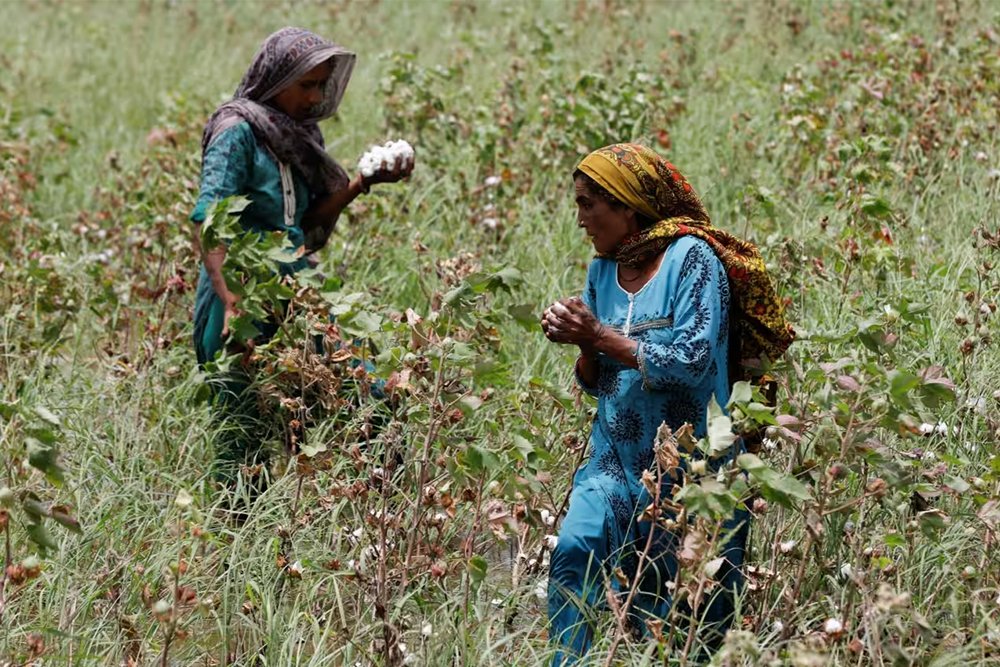
Climate shocks, land-use shifts and weak incentives are forcing mills to look abroad—again.
Pakistan’s cotton harvest has fallen sharply short of official targets, underscoring the country’s growing dependence on imported fibre and adding pressure to already-fragile foreign exchange reserves.
By mid-December, Pakistan had produced 5.3 million cotton bales, barely half of the 10.2 million bales targeted by the Federal Committee on Agriculture, according to data from the Pakistan Central Cotton Committee. Industry estimates suggest final output may reach 5.5–7 million bales at best, implying import requirements of 7–7.5 million bales to meet annual textile consumption of roughly 12 million bales.
The decline reflects both structural and climatic pressures. Cotton acreage fell 11% year-on-year to 2.0 million hectares, squeezed by the expansion of sugar mills into traditional cotton belts and weakened farmer incentives. Climate-induced flooding earlier this year further damaged yields. Despite court rulings to curb sugar mill expansion in cotton-growing districts, enforcement has been uneven.
With international prices low—New York cotton hovered near 66 cents per pound in late December—mills are expected to favour imports. Indeed, Pakistan has already imported $2.82 billion worth of raw cotton, synthetic fibres and related inputs during July–November, up 5% year-on-year, according to the Pakistan Bureau of Statistics.
For the textile sector—Pakistan’s largest export engine, accounting for over half of exports and about 8.5% of GDP—imports ensure continuity but carry a macroeconomic cost. Analysts estimate cotton imports alone could exceed $1–1.2 billion this year, adding strain to reserves that recently rose to $15.9 billion after an IMF disbursement.
The pattern is familiar: falling domestic cotton output pushes mills abroad, which in turn weakens farmgate demand at home. Without credible reforms—restoring acreage, improving seed and water management, and realigning crop incentives—Pakistan risks locking itself into a cycle where cotton farming withers while import bills grow.
