

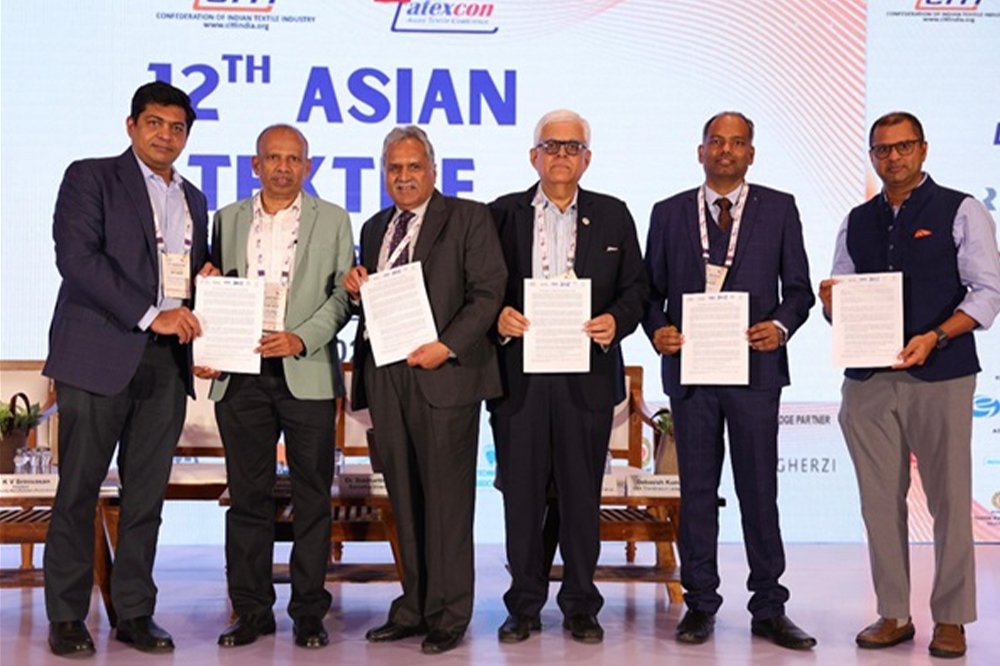
The Hyderabad summit framed the next phase of textile competition around technology, supply-chain resilience and value-added manufacturing rather than low-cost scale alone.
ATEXCON 2026 concluded in Hyderabad with a clear industry message: future textile growth will depend on how quickly manufacturers and policymakers adapt to structural, not cyclical, change. Hosted by the Government of Telangana and co-hosted by the Confederation of Indian Textile Industry (CITI), the 13th Asian Textile Conference was held on April 2–3 under the theme “Re-imagining the Future of Global Textiles”. The event was positioned as an invite-only strategic forum for policymakers, manufacturers, brands and investors across the value chain.
India’s export ambition moves to the centre
The conference landed at a time when India is trying to lift textile and apparel exports to $100 billion by 2030. That ambition is well above current levels: industry reporting put India’s FY2024-25 textile and apparel exports at about $36.6 billion, while the Ministry of Textiles said exports had already reached roughly ₹3 lakh crore and are targeted to triple by 2030. ATEXCON’s agenda reflected that export urgency, with discussions spanning fibres and fabrics, manufacturing and supply chains, markets and trade, AI, automation, circularity and traceability.
Telangana makes a manufacturing pitch
For Telangana, the summit was also an investment signal. State leaders used the forum to position Hyderabad and the wider state as a future textile hub backed by integrated parks, green manufacturing ambitions and technology-led industrial development. The parallel Telangana Textile Dialogue emphasized policy, investment, global connectivity, heritage, innovation and skills, while delegates were also offered a visit to the PM MITRA park being developed in Warangal.
What industry should watch next
The conference’s practical significance will depend on follow-through. The strategic themes were clear: bio-fibres and manmade fibres that can scale, digitally enabled factories, stronger logistics and more resilient supply chains. For mills, machinery suppliers and exporters, the real test is whether India can convert these conversations into faster capacity expansion, higher productivity and more competitive value-added exports in a fragmented global trade environment.
