

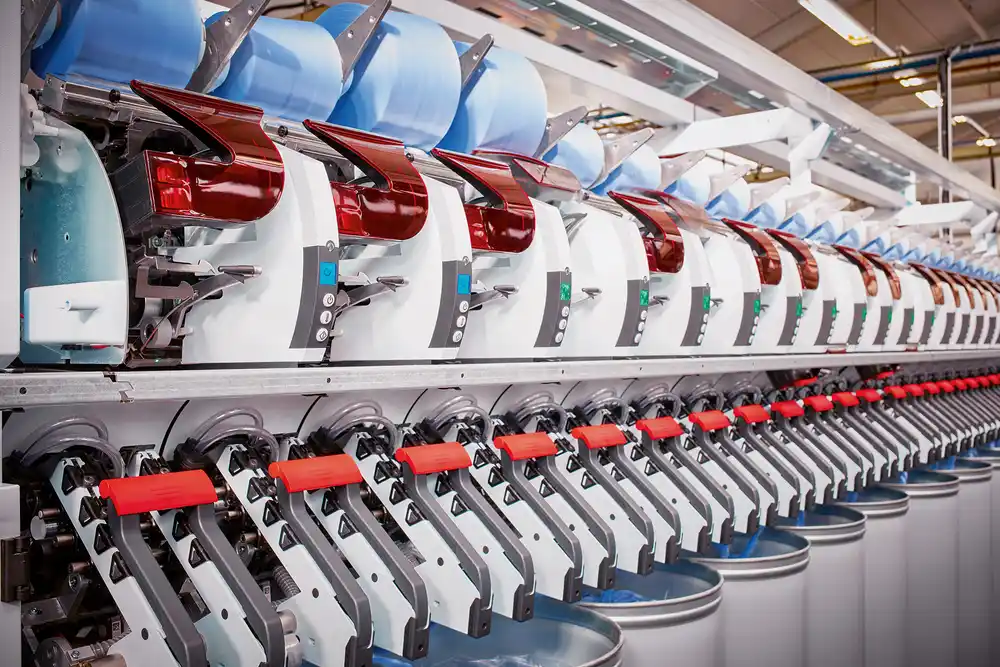
The next machinery cycle will be shaped less by capacity alone and more by automation, energy savings, technical textiles and flexible production.
The global textile machinery market is forecast to grow from $35.7 billion in 2025 to $65.1 billion by 2035, expanding at a 6.2% CAGR, according to Market.us. The outlook reflects a new investment cycle across spinning, weaving, knitting and finishing, as mills replace obsolete equipment with faster, more automated and more resource-efficient systems.
Weaving leads the equipment mix
Weaving machines remain the largest machinery category, accounting for 28.3% of the market in 2025. The segment benefits from demand for apparel fabrics, home textiles, denim and industrial woven structures. Modern air-jet and rapier looms offer higher speed, tighter quality control and lower defect rates, making them attractive for mills seeking productivity gains without expanding floor space.
Spinning, knitting and finishing machinery remain essential, but investment priorities are shifting. Mills are increasingly looking for integrated lines, electronic controls, predictive maintenance, automated material handling and lower energy consumption.
Asia keeps the machinery engine running
Asia-Pacific dominates the market with 45.2% share, valued at $16.1 billion. China, India, Bangladesh and Vietnam continue to anchor global machinery demand because of their scale in apparel exports, integrated textile parks and ongoing modernization programmes.
Cotton remains the leading raw-material segment at 34.6%, reflecting its central role in apparel and home textiles. Garments and apparel account for 52.5% of machinery applications, confirming that clothing still drives the largest share of capital expenditure.
Technology moves into the mill floor
The most important shift is digitalization. IoT sensors, real-time monitoring, AI-assisted process control and predictive maintenance are turning machinery from standalone equipment into connected production platforms. Sustainability is also influencing procurement, with demand rising for low-waste finishing, energy-efficient motors, heat recovery, plasma treatment and machinery compatible with recycled and bio-based fibers.
Atmospheric-pressure plasma holds 64.2% of the plasma-treatment segment because it can be integrated more easily into existing lines than low-pressure systems.
The next signal to watch is whether machinery buyers prioritize lowest capital cost or total operating cost. Mills that invest in automation, lower resource use and technical-textile capability will be better positioned as labour, energy, compliance and buyer requirements become tougher.
