

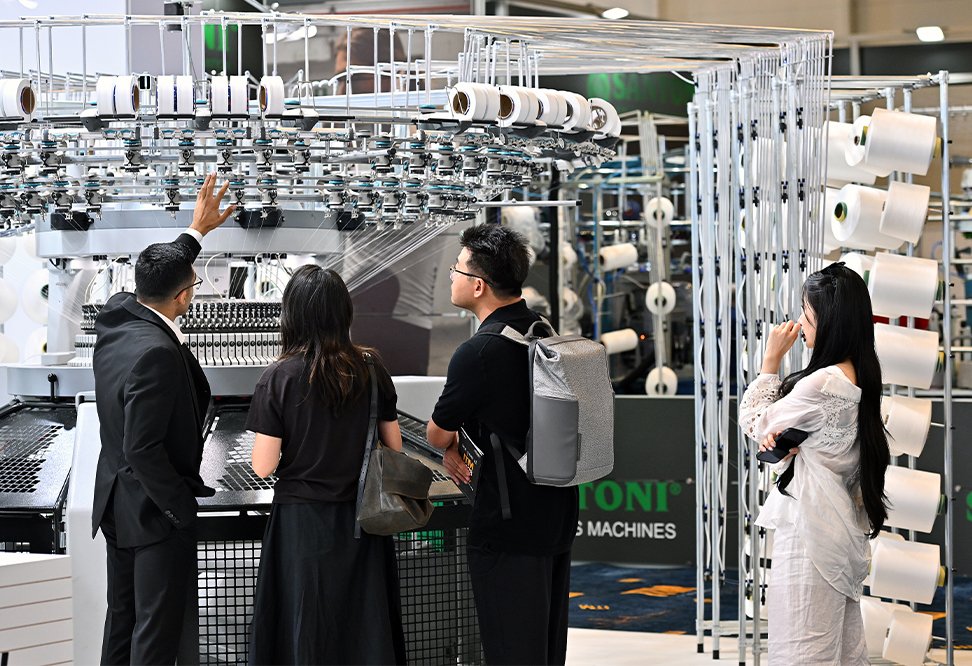
The next machinery cycle will be driven less by capacity additions than by automation, energy efficiency and the ability to produce higher-value knitted fabrics.
The global circular knitting machines market could expand from an estimated US$4.1 billion in 2026 to US$6.0 billion by 2033, representing a 5.6% compound annual growth rate, according to Persistence Market Research. The forecast points to a replacement-led investment cycle as mills seek higher uptime, lower labour dependence, digital controls and greater flexibility for recycled yarns and diversified fabric constructions.
Single jersey remains the volume engine
Single jersey machines are expected to account for 61.8% of the market in 2026, reflecting their central role in large-scale production of T-shirts, innerwear, casualwear and lightweight sportswear. Their commercial advantage remains high output with relatively lower operating complexity.
However, the higher-growth opportunity is shifting towards double jersey systems, which the report expects to grow at more than 6% annually. Demand is being supported by interlock, performance activewear, compression garments, mattress covers, automotive textiles and medical applications—segments where fabric stability, stretch control and quality consistency command better margins.
Needle technology is also evolving. Latch needles are projected to retain a 54.5% share in 2026 because of their compatibility with mainstream cotton, polyester and blended-yarn production. Compound needles, meanwhile, are gaining ground in finer-gauge, technical and performance fabrics where stitch precision and lower yarn stress matter more.
Asia’s scale, Africa’s investment case
Asia Pacific is projected to retain a 51.2% market share, anchored by China, India and Southeast Asia’s large textile manufacturing base. India’s PLI programme and PM MITRA textile parks, alongside continued sourcing diversification towards Vietnam and Bangladesh, are expected to support modernisation demand.
The Middle East and Africa are forecast to be the fastest-growing regions as governments promote textile parks, export manufacturing clusters and more integrated domestic value chains. The commercial test will be whether infrastructure, skilled technical labour and policy continuity can match the pace of machinery investment.
Supplier landscape resets
The market remains fragmented, with European and Japanese suppliers concentrated in premium technology while Asian manufacturers compete aggressively on cost, accessibility and service. A major 2026 development was the restart of Mayer & Cie. under Mayer & Cie. Global after completion of the transfer of its circular-knitting assets to the Huixing-backed ownership group in April. The company says development and production will continue from Albstadt, Germany.
For knit fabric producers, the decisive procurement question is no longer simply machine speed: it is whether a platform can support energy management, rapid style changes, recycled-yarn processing, remote diagnostics and reliable lifecycle service.
