

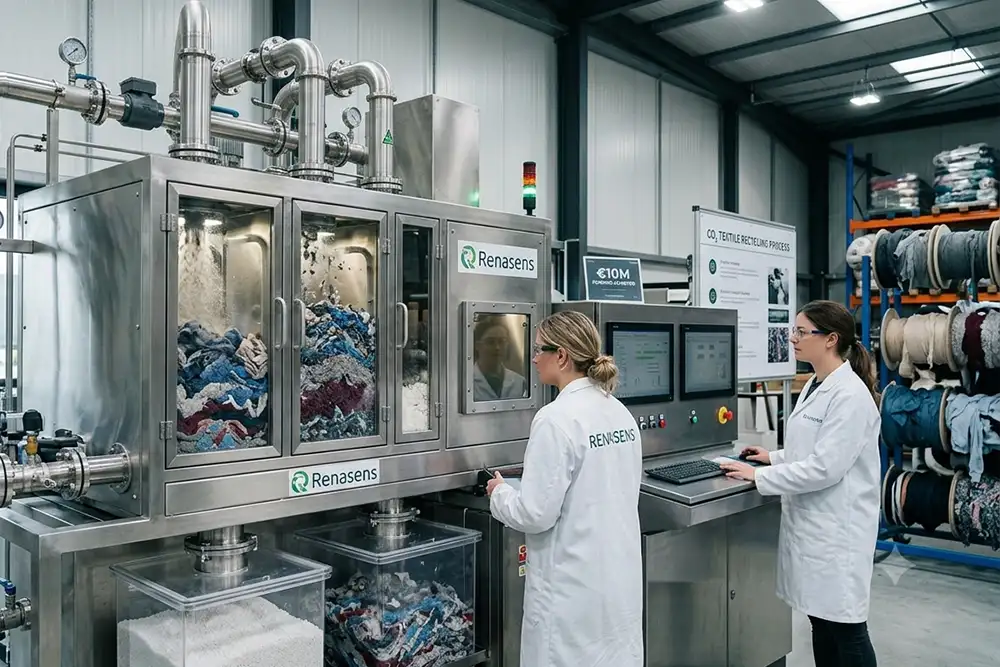
The Swedish start-up aims to recover intact cotton and polyester fibres without water or polymer depolymerisation, tackling one of textile recycling’s hardest feedstocks.
Swedish recycling technology company Renasens is advancing an industrial pilot that uses modified supercritical carbon dioxide to process dyed and blended textile waste. The company raised €10 million in seed funding in March 2026, led by Extantia with participation from Course Corrected VC and Norrsken Launcher, to establish the facility in Borås, Sweden.
The process targets a persistent circularity bottleneck: polycotton and other blended, treated fabrics that are difficult to recycle into fibres suitable for new textiles.
Keeping polymers—and value—intact
Renasens first extracts dyes, finishes and other additives before separating the constituent fibres. Unlike conventional chemical recycling routes that break polymers into monomers, its process is designed to preserve fibres at the macromolecular level, keeping cotton and polyester intact for re-entry into yarn and fabric production.
Supercritical CO₂ combines gas-like diffusion with liquid-like solvent behaviour under controlled pressure and temperature. Renasens says its modified system avoids water and toxic processing chemicals and can be configured in modular units within existing industrial facilities. The recovered material should therefore be usable without requiring manufacturers to install an entirely new downstream production system.
Commercial validation begins
The company has started supplying recovered cotton and polyester fibres to manufacturers in Portugal and Italy. The Borås pilot will test whether the technology can maintain fibre quality, process variable post-consumer feedstock and achieve commercially competitive operating costs at larger throughput.
Renasens is also coordinating the PureFiber Recovery project with RISE, KTH, the University of Borås, ITA Aachen, Saxion University and industry partners including Houdini Sportswear and Kentaur. The programme’s longer-term ambition is to support recycling of 100,000 tonnes of blended textiles by 2030.
Pressure moves to industrial economics
The concept could reduce wastewater and avoid the fibre shortening associated with mechanical recycling. Yet the decisive questions remain energy demand for CO₂ compression, contaminant tolerance, solvent recovery, throughput and fibre performance after repeated recycling.
The Borås pilot will show whether supercritical CO₂ can move from promising separation science to dependable textile infrastructure.
