

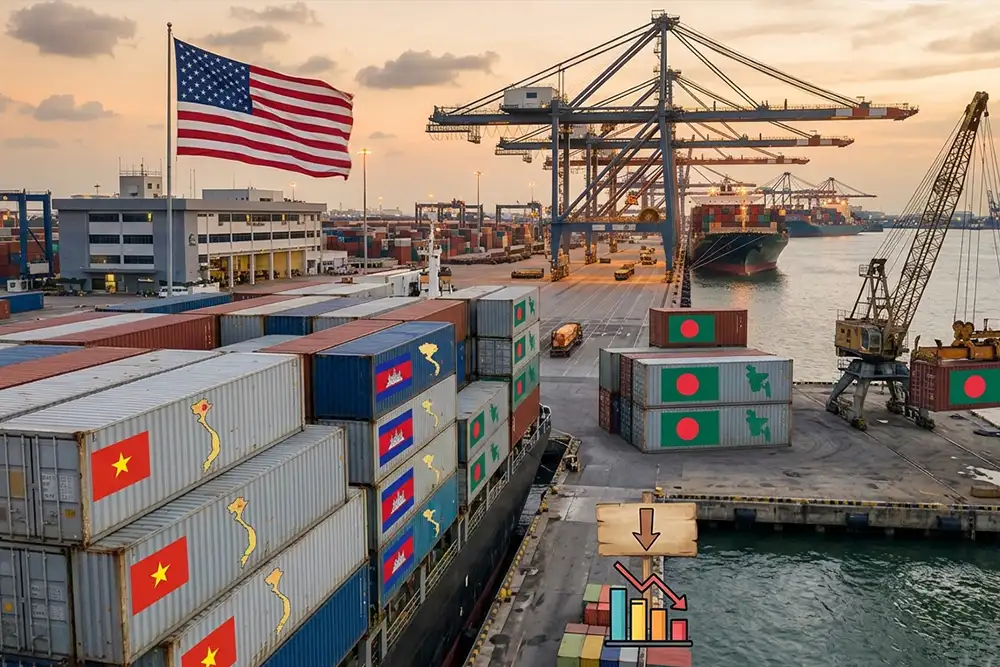
Bangladesh’s May recovery offers some relief, but declining volumes and unit prices show that competitive pressure in the US market is intensifying.
Bangladesh’s apparel exports to the United States fell 8.08% year on year to approximately $3.24 billion during January-May 2026, compared with $3.53 billion in the same period of 2025. The country nevertheless remained the second-largest apparel supplier to the US after Vietnam, according to Office of Textiles and Apparel data reported by Bonik Barta.
May provided an early sign of improvement. US apparel imports from Bangladesh increased 6.04% to $582 million during the month, reversing part of the weakness recorded earlier in the year.
Competitors capture available growth
The decline occurred as the overall US apparel import market contracted 9.25% in value to $28.78 billion and 9.48% by volume during the five months. Bangladesh therefore performed slightly better than the market average in value terms.
However, several competitors expanded despite the weaker market. Vietnam’s exports rose 1.46% to $6.39 billion, Cambodia’s increased 14.90%, and Indonesia’s gained 5.49%. Their shipment volumes, measured in square-metre equivalents, rose 3.01%, 18.03% and 13.16%, respectively.
China’s exports fell 42.75%, while India’s declined 26.37%, showing that sourcing displaced from these countries is being captured selectively rather than flowing automatically to Bangladesh.
Prices remain under pressure
Bangladesh’s shipment volume declined 6.21%, while its average unit value fell about 2%. The combination indicates pressure on both order quantities and pricing—a difficult position for factories facing higher wages, energy costs and financing expenses.
BGMEA attributed part of the decline to an unusually high 2025 base, when buyers advanced shipments ahead of expected US tariff changes. It also pointed to buyer caution, election-related uncertainty and production disruptions around two Eid holidays.
The next test is whether May’s rebound continues. Bangladesh’s new US trade agreement, including a 19% reciprocal tariff and proposed duty relief for qualifying apparel using US cotton or man-made fibres, could support orders—but only if exporters strengthen MMF capacity, traceability and delivery reliability.
