

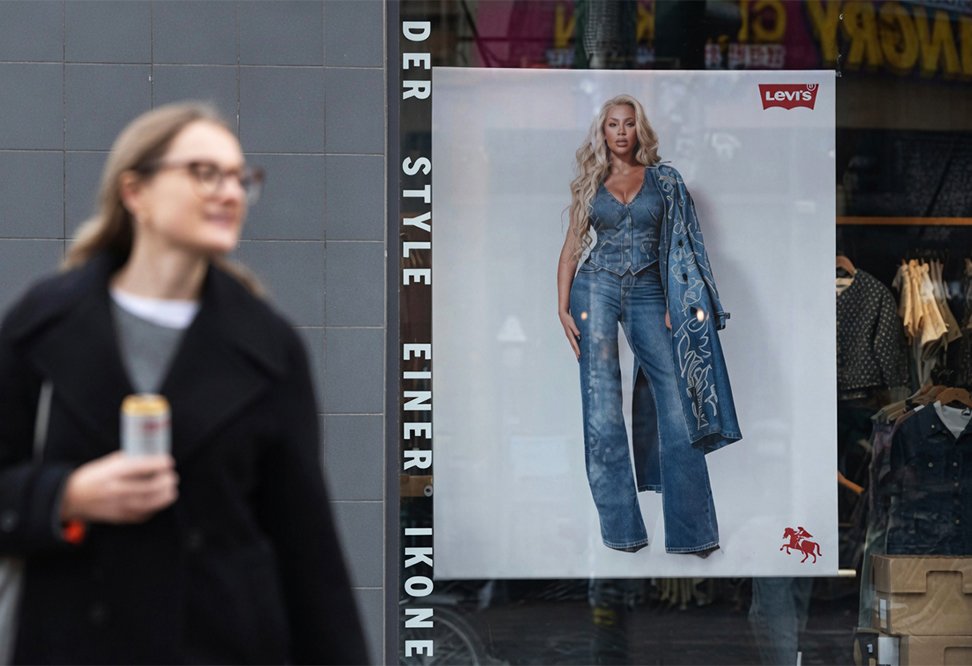
Fashion visibility has increased, but Jefferies argues that the industry’s recent commercial performance has been more subdued than the denim revival narrative suggests.
The widely reported denim resurgence has not translated into a broad-based sales boom, according to Jefferies, which says US jeans have underperformed the wider apparel market over recent years.
The investment bank’s analysis challenges the idea that high-profile campaigns, changing silhouettes and renewed designer interest have produced exceptional category growth. Jeans remain a wardrobe staple, but competition from leggings, sweatpants and other comfort-led apparel has limited overall expansion.
Fashion heat exceeds market growth
Denim has generated considerable cultural momentum through celebrity advertising, looser fits and the return of flared, barrel-leg, straight and skinny silhouettes. Yet the proliferation of styles may be redistributing purchases across fits and brands rather than materially increasing the number of jeans consumers buy.
This creates a more complex planning environment. Retailers must carry a broader assortment of rises, cuts, washes and sizes, increasing stock-keeping units and inventory risk. For mills and garment suppliers, fashion fragmentation also means smaller orders, more frequent product development and stronger pressure for flexible minimum quantities and rapid replenishment.
Women’s denim provides the opening
Jefferies sees women’s jeans as the category’s more attractive growth opportunity. Wider consumer acceptance of multiple silhouettes gives brands more reasons to refresh assortments, while fit innovation and premium positioning can support higher average selling prices.
Recent Levi Strauss results offer evidence that selected brands can outperform a restrained category. Levi’s reported an 8% increase in second-quarter revenue to $1.56 billion and raised its fiscal 2026 sales-growth forecast to 7–7.5%. Management highlighted strong women’s apparel demand, loose silhouettes and early traction for its premium Blue Tab range, including jeans priced at about $300.
Selective gains, not a universal boom
The distinction matters for denim manufacturers. Demand is likely to favour suppliers that can execute fashion-right fabrics, stretch and rigid constructions, lighter weights, varied washes and shorter development cycles. General capacity expansion based solely on a presumed denim supercycle would carry greater risk.
The next signal will come from whether women’s denim growth extends beyond leading brands and premium consumers into sustained unit growth across the mass market. Until then, the market looks less like an industry-wide boom and more like a selective opportunity shaped by fit, pricing and brand execution.
