

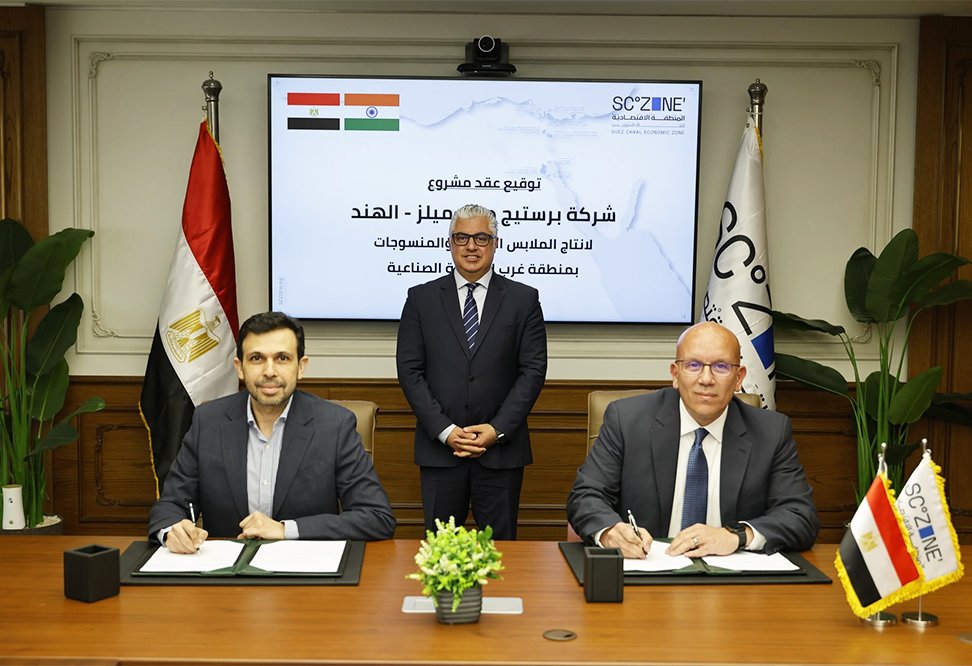
The Indian investment strengthens Egypt’s emergence as a Mediterranean denim-production base serving European, Middle Eastern and African markets.
India’s Prestige Denim Mills will invest $20 million in an integrated denim-fabric plant in Egypt’s West Qantara Industrial Zone, under the Suez Canal Economic Zone. The project will be the first Indian manufacturing investment in the zone and adds another export-oriented textile operation to Egypt’s expanding industrial cluster.
Weaving, dyeing and finishing under one roof
The facility will occupy a 100,000-square-metre site and integrate weaving, dyeing and finishing. Planned annual capacity is 20 million metres of denim fabric, while the project is expected to create about 1,000 direct jobs. Prestige intends to export approximately 70% of production, with the balance supplying Egypt’s domestic textile and apparel industry.
The integrated configuration should give the manufacturer greater control over fabric quality, shade consistency, lead times and product development than a fragmented production model. For buyers, the plant could offer a new regional source of finished denim fabric closer to European and Middle Eastern garment-making centres.
West Qantara builds textile scale
SCZONE says cumulative investment in textile and ready-made garment projects in West Qantara has exceeded $1 billion. Prestige joins manufacturers from several Asian and European countries that are using Egypt as a production and export platform.
Location is a central part of the proposition. Egypt offers access to the Suez Canal logistics corridor and comparatively short shipping routes to Europe. The EU-Egypt Association Agreement, effective since 2004, established a free-trade area by eliminating tariffs on qualifying industrial products, subject to applicable origin rules. In 2025, the EU was Egypt’s largest trading partner and destination for 27.7% of Egyptian exports.
A new competitive node for denim
The investment signals growing competition among denim-producing countries to place capacity nearer major consumer markets. Egypt can combine export access, labour availability and an expanding textile ecosystem, but the plant’s competitiveness will ultimately depend on energy reliability, environmental performance, cotton and yarn sourcing, wastewater treatment and execution quality.
No commissioning timetable was disclosed. The next indicators will be construction progress, machinery selection and whether Prestige develops the plant around conventional volume denim or higher-value fabrics with stretch, recycled content, lighter weights and verified sustainability data.
