

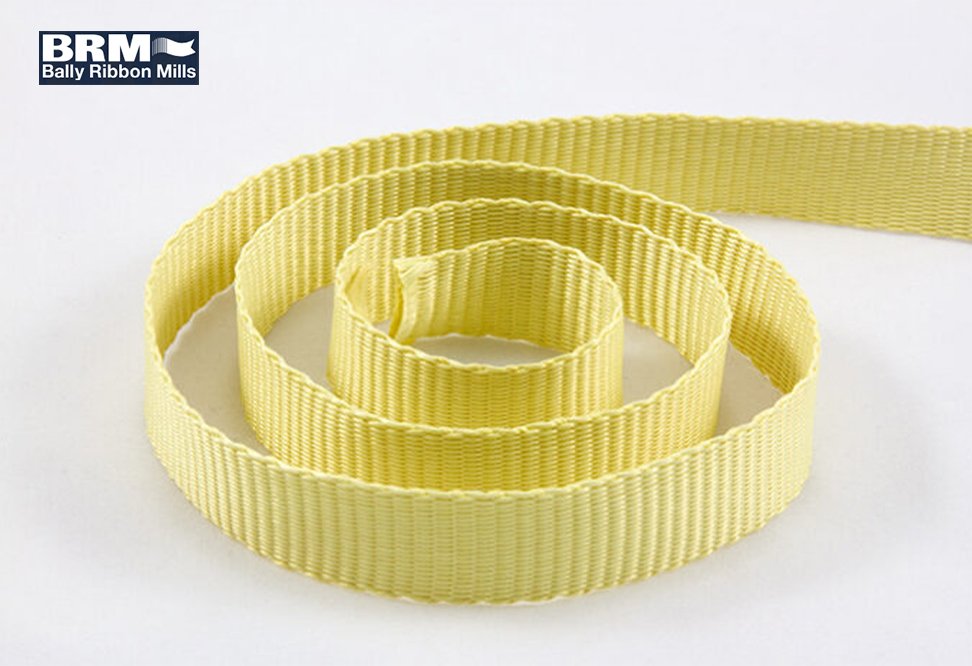
The engineered narrow fabrics offer up to 50% higher strength and 40% weight savings for defence, aerospace, parachute and industrial-safety systems.
Bally Ribbon Mills has introduced high-performance tapes and webbings made with Kevlar EXO, extending the next-generation aramid fibre into load-bearing components for defence, aerospace and industrial protective applications.
The Pennsylvania-based manufacturer says the new webbings are engineered to provide 40–50% greater tenacity than comparable legacy Kevlar constructions. At equivalent strength targets, the materials can deliver weight reductions of 15–40%, potentially allowing equipment designers to reduce system mass without sacrificing load-bearing performance.
Strength moves into narrow fabrics
Kevlar EXO was initially developed for advanced ballistic protection, combining high strength with greater flexibility, cut resistance and inherent thermal performance. The fibre is produced through a modified aramid chemistry designed to improve molecular alignment; its manufacturer reports around 30% higher strength than standard aramid body-armour fibres.
Bally Ribbon Mills is translating these properties into engineered webbings for seam reinforcement, harnesses, parachute assemblies and other high-tensile-load applications. Lower elongation and higher strength-to-weight ratios are particularly valuable where webbing must restrain, suspend or distribute loads while adding minimal bulk.
Customisation remains central
The company can customise the material’s width, colour, weave architecture and performance characteristics for specific programmes. Development support extends from prototypes to full-scale production, targeting regulated markets where consistency, traceability and repeatable mechanical performance are essential.
Potential end uses extend beyond personal protective equipment. Bally has previously identified parachutes, aerospace safety systems, deep-space structures and specialised military equipment as promising applications for Kevlar EXO narrow fabrics. Its established Kevlar webbing portfolio also serves fall protection, firefighting equipment and load-bearing systems requiring resistance to heat, flame and abrasion.
Qualification will determine adoption
The announcement does not provide pricing, available widths, tensile values by construction, production capacity or details of completed military and aerospace certifications.
Commercial uptake will therefore depend on application-level testing, including tensile retention, fatigue, abrasion, flexing, environmental exposure and compatibility with stitching and hardware. For technical-textile producers, the launch illustrates how advanced fibres create value only when their properties can be retained through weaving, conversion and final-system integration.
