

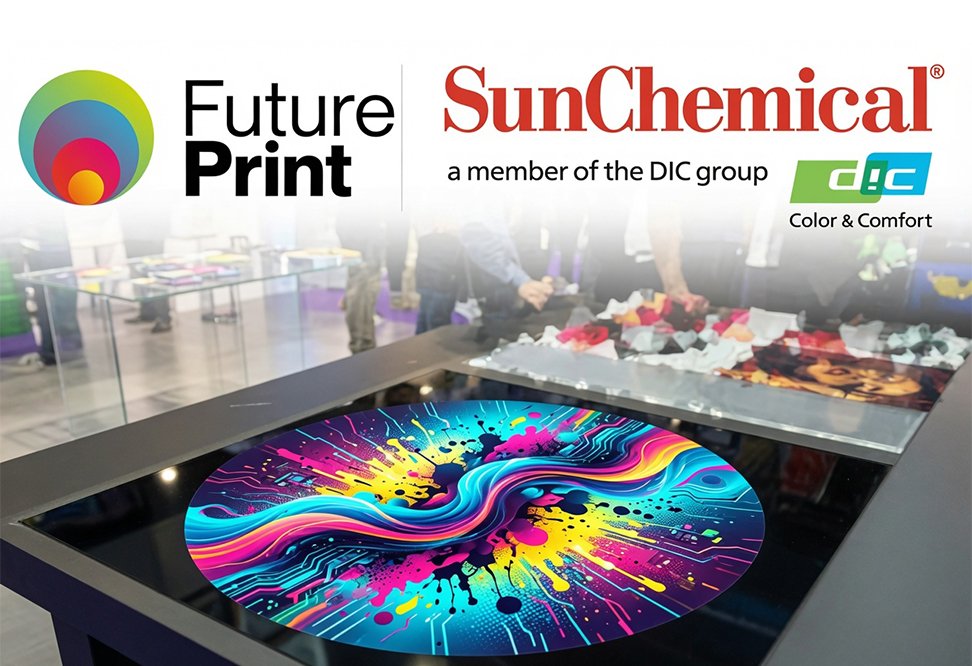
The company will showcase upgraded pigment, reactive, acid and sublimation inks as regional printers seek faster production, broader fabric compatibility and more reliable digital workflows.
Sun Chemical is presenting an expanded portfolio of digital textile and graphics-printing technologies at Future Print Brazil 2026, held from July 14–17 at Distrito Anhembi in São Paulo.
The exhibition gives the ink manufacturer a platform to strengthen its position in Brazil and the wider Latin American market, where textile printers are investing in digital production to support shorter runs, faster design changes and more diversified product portfolios. Sun Chemical is exhibiting at stand E175.
Pigment performance moves higher
The principal textile development is an upgraded version of Xennia Sapphire PC pigment inks for printers using Kyocera printheads. Sun Chemical says the formulation has been improved to deliver stronger fastness performance across different fabric types.
Pigment inks are commercially attractive because they can print multiple fibre categories and generally require fewer wet-processing stages than reactive or acid systems. However, print quality, handle, crocking resistance and wash fastness remain critical adoption criteria, particularly for apparel and home-textile applications.
Sun Chemical has not disclosed quantified improvements in fastness, productivity, ink consumption or curing requirements for the upgraded formulation.
A full chemistry portfolio
The company is also displaying ElvaJet Opal and ElvaJet Topaz sublimation inks, primarily aimed at polyester-based textiles and transfer printing. Its wider textile portfolio includes Xennia Amethyst reactive inks for cellulosic fibres and Xennia Agate and Ruby acid inks for substrates such as polyamide, silk and wool.
This breadth allows printers to source ink technologies for sportswear, fashion, signage, décor and specialist textile applications from one supplier, although machinery compatibility, pretreatment, fixation and colour-management requirements differ substantially by ink class.
Reliability becomes the selling point
Sun Chemical will also highlight SEPAREL hollow-fibre membrane modules, which remove dissolved gases from aqueous, solvent and UV inks. Degassing can help reduce nozzle failures and improve jetting stability in industrial inkjet systems, where downtime and printhead damage can outweigh ink-price savings.
The commercial test will be whether Sun Chemical’s regional manufacturing, warehousing and technical support can translate these technologies into lower downtime, repeatable colour and reduced processing cost for Latin American printers. Future Print will also indicate how quickly the region is moving from analogue production towards integrated industrial digital textile printing.
