

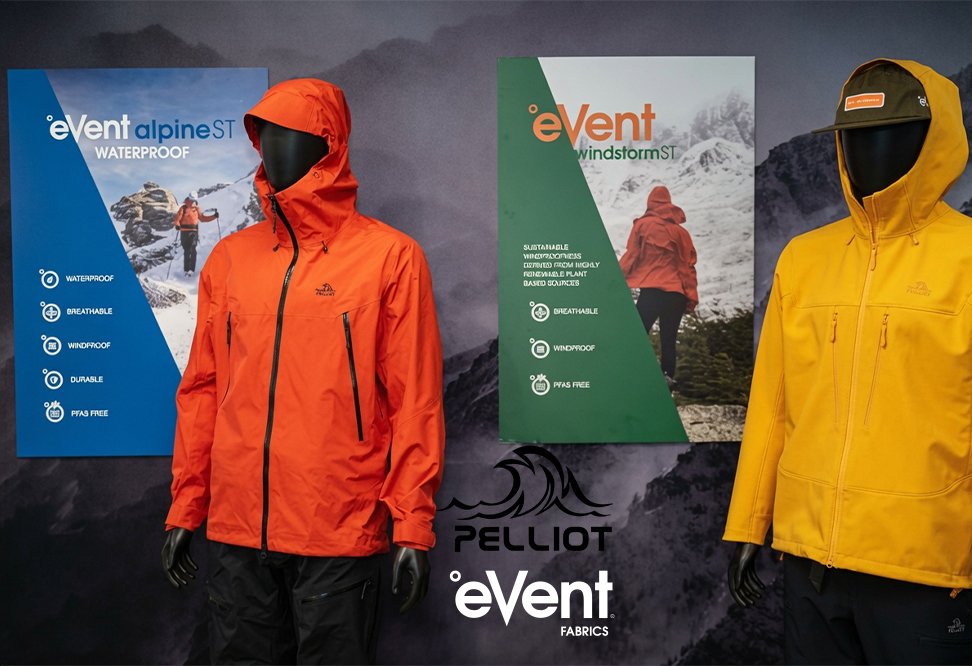
The partnership will place eVent’s alpineST and windstormST membrane technologies in PELLIOT jackets, testing whether lower-impact waterproof and windproof materials can scale in China’s expanding outdoor market.
eVent Fabrics has partnered with Chinese outdoor brand PELLIOT to introduce two PFAS-free functional laminates across the brand’s forthcoming hard-shell and soft-shell apparel ranges.
The agreement covers eVent’s alpineST waterproof-breathable laminate and windstormST windproof soft-shell technology. PELLIOT plans to use windstormST in a Fall/Winter 2026 jacket, followed by alpineST in a Spring/Summer 2027 hard-shell product.
Two routes away from PFAS
The alpineST construction combines eVent’s PFAS-free membrane with performance face fabrics and backers. It also uses a C0 durable water-repellent finish, meaning the treatment is formulated without fluorocarbon chemistry. The laminate is intended for demanding alpine activities requiring protection from rain and adverse weather.
WindstormST takes a different material approach. It combines a plant-derived membrane with recycled or otherwise lower-impact face and backing fabrics. The laminate is designed to block wind while providing resistance to light rain and snow, positioning it for soft-shell garments used across hiking, travel and everyday outdoor applications.
China becomes a commercial test
The collaboration is commercially significant because PELLIOT operates at scale in China’s fast-growing outdoor market, serving mountaineering, hiking, skiing and travel consumers. For eVent, the partnership offers a route to move PFAS-free membrane technology beyond niche Western outdoor brands and into a larger-volume Asian market.
For textile mills and laminate suppliers, the shift increases demand for compatible face fabrics, backers, adhesives and non-fluorinated water-repellent finishes. Performance must remain consistent across hydrostatic resistance, breathability, wind blocking, seam sealing, abrasion and laundering.
Claims will require evidence
Neither company disclosed expected production volumes, fabric specifications, retail prices or quantified environmental improvements. “PFAS-free,” “plant-based” and “recycled” describe material attributes, but do not by themselves establish a lower lifecycle impact.
The next test will be whether PELLIOT publishes measurable performance data, membrane composition, recycled-content percentages and lifecycle indicators. Commercial success could encourage more Chinese outdoor brands to replace fluorinated membrane and finishing systems without weakening the protection consumers expect.
