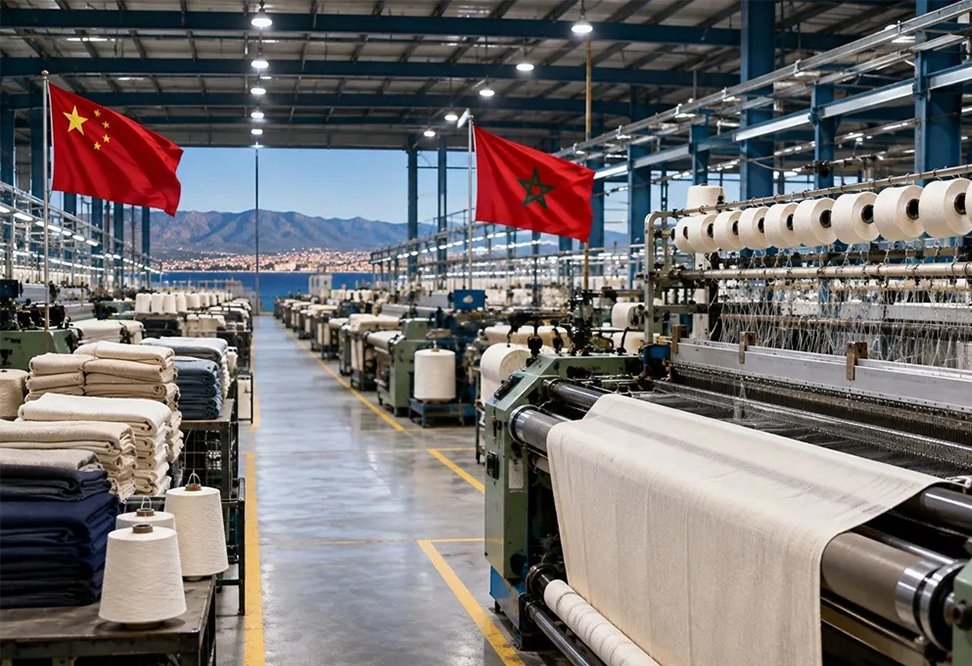
The Chinese group’s planned 34-hectare complex will span spinning, weaving, dyeing and garment manufacturing, strengthening Morocco’s position as a vertically integrated nearshore sourcing base for Europe.
China’s Shengtai Intelligent Manufacturing Group has cleared two important regulatory hurdles for its planned MAD2.29 billion ($229 million) green textile industrial park in Morocco, advancing one of the country’s largest recent textile investments.
Shengtai has received an Enterprise Overseas Investment Certificate from Hunan Province’s Department of Commerce and an overseas-investment filing notice from the provincial Development and Reform Commission. The company signed its investment agreement with the Moroccan government in March 2025.
From yarn to finished garments
The project will occupy about 34 hectares and create an integrated manufacturing chain covering spinning, weaving, knitting/dyeing, finishing and garment production.
At full capacity, Shengtai plans annual production of 100,000 spindles of cotton yarn, 10,800 tonnes of dyed fabrics, 15 million metres of woven fabrics and 22 million garments. The complex will also incorporate its own heat-generation and wastewater-treatment facilities. Construction is planned in phases over a period of up to five years.
The wider project is expected to create around 7,000 direct jobs and 1,500 indirect jobs.
Shengtai’s Moroccan subsidiaries include Euwen Textiles, whose operations in Fez and Skhirat form part of the group’s expanding production footprint.
Morocco strengthens its nearshore proposition
The investment goes beyond another garment factory. By adding upstream spinning, fabric production and wet processing, it can reduce Morocco’s dependence on imported textiles and shorten the lead time between material production and European apparel delivery.
That matters as brands increasingly seek China+1 sourcing, shorter replenishment cycles and geographically diversified supply chains. Morocco combines proximity to Europe with established garment manufacturing and preferential trade access.
Execution now becomes the test
Shengtai cautions that further approvals remain necessary and that financing, construction and market conditions could delay or alter the project.
The strategic signal is nevertheless significant: Chinese textile groups are increasingly exporting entire vertically integrated supply chains, not just garment capacity. If fully realised, Shengtai’s investment could accelerate Morocco’s transition from a cut-and-sew nearshoring location into a more complete textile-to-apparel manufacturing hub.