

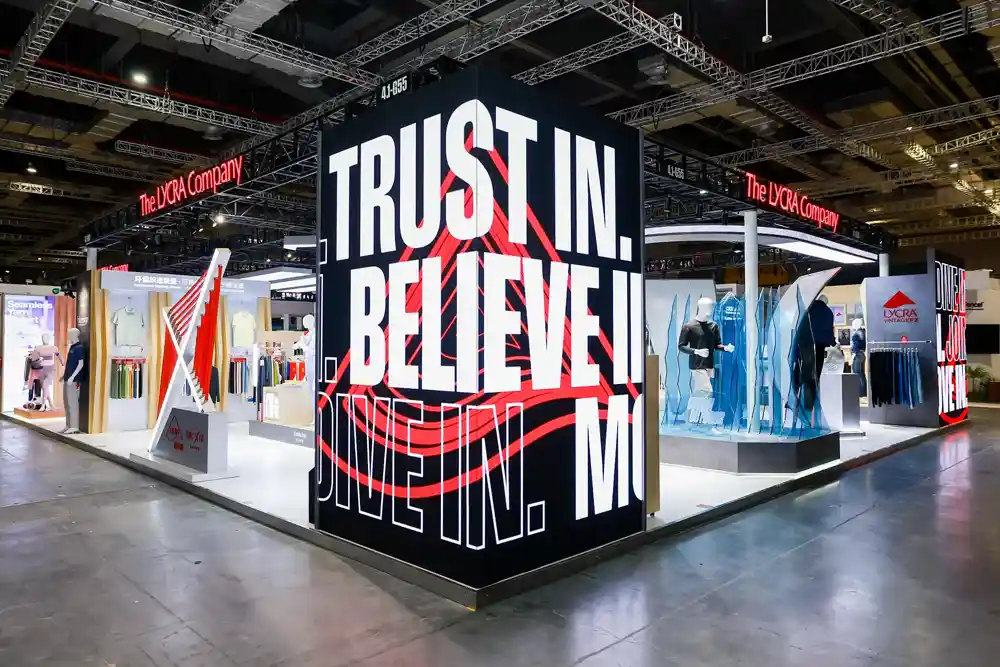
The Shanghai showcase pairs 19 supply-chain partners with new COOLMAX, LYCRA FiT400 and 70%-renewable LYCRA technologies, shifting the trade-show model from fibre display toward commercially ready fabric and garment solutions.
The LYCRA Company has expanded its collaborative sourcing model at Intertextile Shanghai Apparel Fabrics 2026, assembling 19 co-exhibitors across an 895-square-metre pavilion to demonstrate how fibre technologies translate into finished fabrics and garments.
At its centre is a 356-square-metre Lifestyle District, developed with Jingzili New Material, JYT Textile, Lianxingfa Knitting and Trend Textile. The concept extends LYCRA’s 2025 “ALL IN” initiative by bringing fibre suppliers, mills and garment applications together in one sourcing environment.
New cooling technology targets wovens
Among the launches is COOLMAX CloakFX fibre, developed for woven fabrics. It combines moisture management with technology designed to reduce the visible appearance of sweat and improve wet and dry opacity.
The fibre is made from 100% recycled PET and carries Global Recycled Standard certification, giving mills a performance option that also reduces reliance on virgin polyester.
LYCRA is also previewing LYCRA FiT400 fibre for wovens, engineered to provide durable low-to-moderate mechanical stretch while retaining conventional woven aesthetics.
For knits, FiT400 has been reorganised into Essential, Expanded and Elevated performance tiers. The existing fibre is a bicomponent technology containing 60% recycled PET and 14.4% bio-derived resources, with applications spanning activewear, athleisure, swimwear and workwear.
Renewable elastane moves closer to scale
A further focus is RENEWABLE LYCRA fibre, containing 70% renewable material derived partly from US field corn. Its bio-derived BDO feedstock replaces a substantial portion of the fossil-derived raw material used in conventional elastane while retaining equivalent stretch and durability performance.
LYCRA’s Intertextile strategy highlights a wider sourcing shift: ingredient-fibre companies increasingly need to demonstrate complete commercial applications rather than technical specifications alone.
For mills and brands, the competitive question is becoming how effectively recycled feedstocks, renewable chemistry and performance functions can be combined in fabrics that require minimal process changes and can move quickly into bulk production.
