

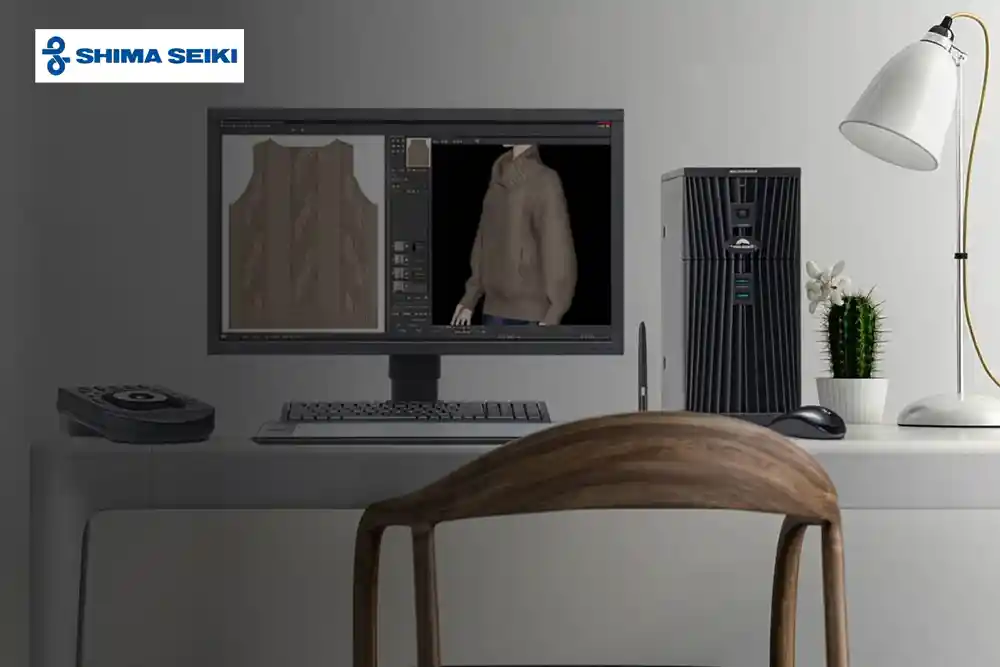
The Japanese knitting-technology specialist will showcase APEXFiz at Première Vision Paris, demonstrating how virtual sampling can connect yarn-level simulation directly with production-ready knitting data.
SHIMA SEIKI will focus entirely on digital product creation at Première Vision Paris 2026, using its APEXFiz® Design platform to demonstrate how fashion companies can reduce physical sampling, shorten development cycles and connect virtual designs more directly with manufacturing.
The Japanese company will exhibit in Première Vision’s Smart Creation area in Hall 3, booth 3L5, during the September 1–3 show at Paris Nord Villepinte. No knitting machinery is listed for the Paris exhibit; the emphasis is specifically on APEXFiz 3D design software and digital workflow integration.
Yarn data becomes a virtual prototype
APEXFiz supports product development from planning and design through realistic textile simulation and 3D virtual sampling for flat-knitted products.
A key feature is its use of scanned data from actual yarns. SHIMA SEIKI says this allows digital samples to reproduce material appearance closely enough to function as development prototypes, potentially eliminating some physical samples and the associated yarn, labour, shipping and lead time.
Once a knitted design is approved, APEXFiz can automatically generate knitting data that can subsequently be converted into machine data for physical production. This creates a tighter digital thread between design approval and factory execution.
Beyond flat knitting
The software is not restricted to knitwear. SHIMA SEIKI says APEXFiz can also simulate woven fabrics, circular knits, printed textiles and embroidery, supporting its use alongside other 3D apparel platforms.
That interoperability became more important in March, when SHIMA SEIKI announced a technology partnership with CLO Virtual Fashion. Dedicated export and one-click import functions were developed to improve movement of APEXFiz material data into CLO’s garment-simulation environment.
Sampling becomes the productivity target
For brands and suppliers, the commercial opportunity is not simply better visualisation. The value lies in reducing sample iterations, material consumption, courier costs and development time, while moving approved designs more quickly toward production.
The next benchmark will be measurable adoption: how much virtual sampling actually reduces physical prototypes, development lead times and cost per style across commercial apparel programmes.
