

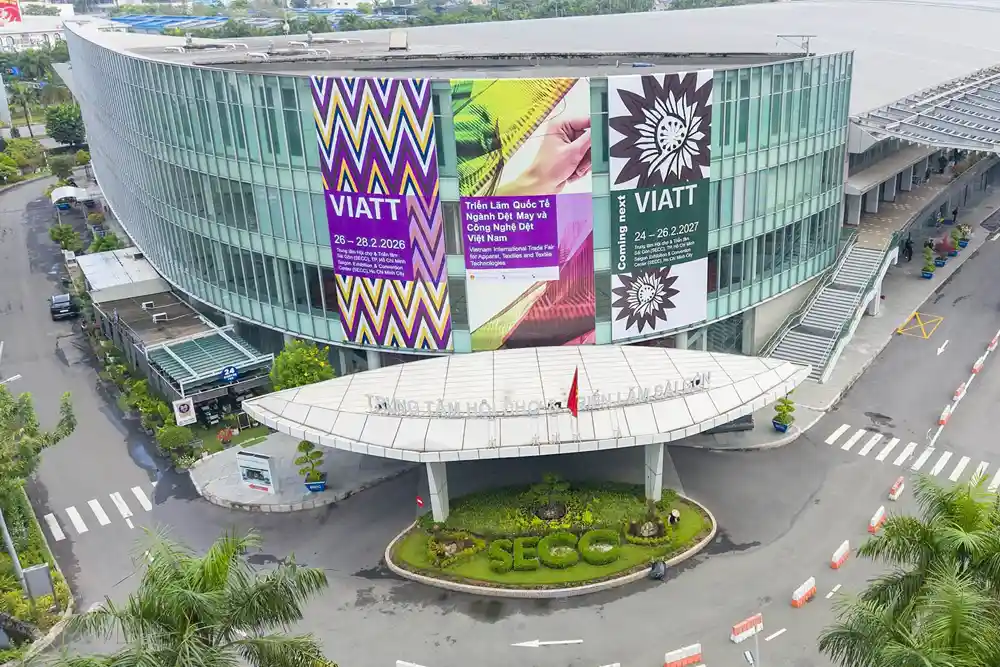
With more than 60% of textile inputs still imported, Vietnam is targeting deeper domestic sourcing, digitalisation and greener production as it pursues $48 billion in textile and garment exports in 2026.
Vietnam’s textile industry is moving from capacity-led expansion toward higher-value materials, stronger domestic supply chains and technology-intensive manufacturing, a transition that will shape the fourth edition of the Vietnam International Trade Fair for Apparel, Textiles and Textile Technologies (VIATT) in Ho Chi Minh City.
Scheduled for 24–26 February 2027 at the Saigon Exhibition and Convention Center, VIATT will span 18,000 sq metres and cover apparel fabrics and fashion, home and contract textiles, and technical textiles and technologies.
$48 billion export target
Vietnam’s textile and garment sector generated more than $22 billion in exports during the first half of 2026 and is maintaining a full-year target of $48 billion.
Yet more than 60% of production inputs remain imported, leaving greater localisation and upstream investment among the industry’s main strategic priorities. Industry leaders increasingly argue that future growth must come from productivity, market diversification, digitalisation and greener manufacturing rather than simply adding production capacity.
Sustainability enters the sourcing floor
VIATT 2027 will again feature its Econogy Hub and Econogy Check, bringing certified sustainable fibres, recycled materials, circular technologies and traceability solutions into the sourcing environment.
The format is increasingly relevant as export manufacturers face tighter ESG, traceability and product-compliance requirements in Europe and other major markets. Buyers are also looking further upstream, evaluating yarn, fabric and processing suppliers alongside garment factories.
Regional sourcing platform expands
The 2026 edition attracted nearly 460 exhibitors from 21 countries and regions and more than 17,000 visits representing 54 markets. More than 350 business-matching meetings connected exhibitors with buyers from over 20 countries and regions.
For Vietnam, the strategic challenge is clear: maintaining its garment-export scale while capturing more value upstream.
VIATT 2027 will provide an early indicator of that transition. The technologies and materials attracting serious buyer interest—particularly automation, technical textiles, sustainable fibres, recycling and traceability systems—will show where Vietnam’s next round of textile investment is likely to concentrate.
