

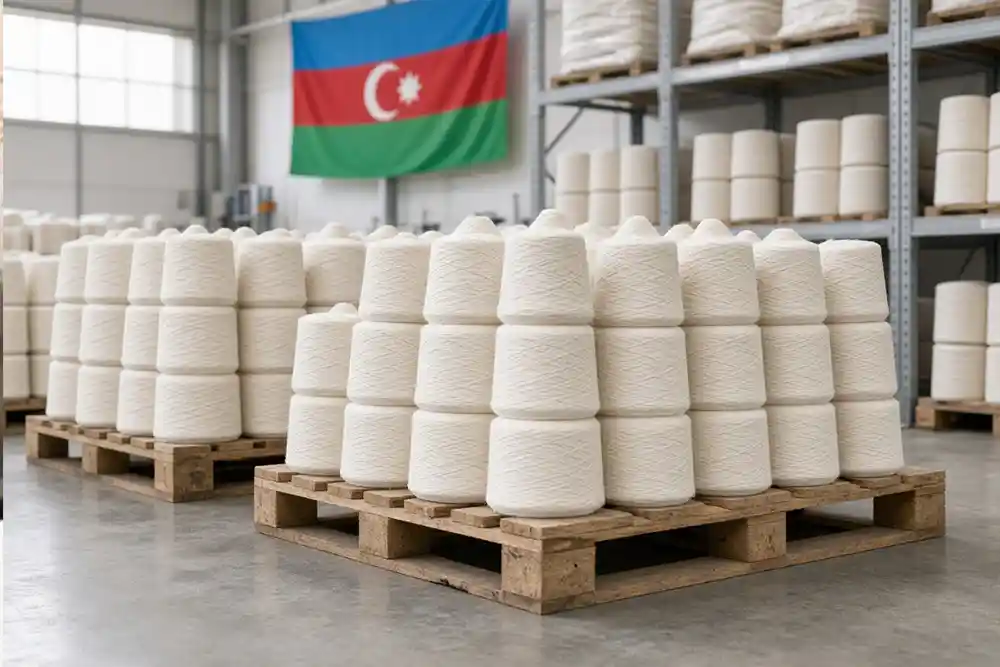
Cotton yarn shipments rose 88.5% by volume and 81.7% by value in January–July 2026, signalling faster development of Azerbaijan’s downstream cotton-processing industry alongside continued growth in raw fibre exports.
Azerbaijan exported about 13,700 tonnes of cotton yarn worth $31 million during January–July 2026, almost doubling shipments from a year earlier as the country expands non-oil manufacturing and captures more value from its domestic cotton crop.
State Customs Committee data show export volumes increased 88.5%, or 6,450 tonnes, while export earnings rose 81.7%, or $13.9 million.
Seven months surpass full-year 2024
The acceleration is particularly striking against recent annual performance. Azerbaijan exported 11,187 tonnes worth $31.29 million in 2023 and 11,548 tonnes worth $28.55 million in 2024.
This means the country earned more from cotton-yarn exports in the first seven months of 2026 than during the entirety of 2024, while shipping almost 19% more volume.
The implied average export value for January–July was about $2.26/kg, slightly below the roughly $2.36/kg indicated by the corresponding 2025 figures. Volume growth is therefore running ahead of value growth, suggesting lower average realisations even as export demand strengthens.
Cotton processing gains momentum
The expansion extends beyond yarn. Azerbaijan exported 97,289 tonnes of cotton fibre worth $137.1 million during January–July, up 27.5% by volume and 24.9% by value.
Domestic cotton-yarn production also increased 33.6% to 14,815 tonnes, meaning exports represented a substantial proportion of current production.
Government export data separately show cotton-yarn export value rising 81.9% year on year, while Azerbaijan’s wider non-oil exports excluding non-monetary gold increased 18.3% to $2.5 billion.
Moving further down the value chain
For Azerbaijan, the strategic opportunity is to convert more domestically produced cotton into yarn, fabric and eventually finished textile products rather than relying predominantly on fibre exports.
The next indicators to watch are spinning-capacity investment, export-market diversification and unit values. Sustained growth will depend not simply on selling more yarn, but on improving quality, product mix and downstream value addition as Azerbaijan builds a larger textile manufacturing base.
