

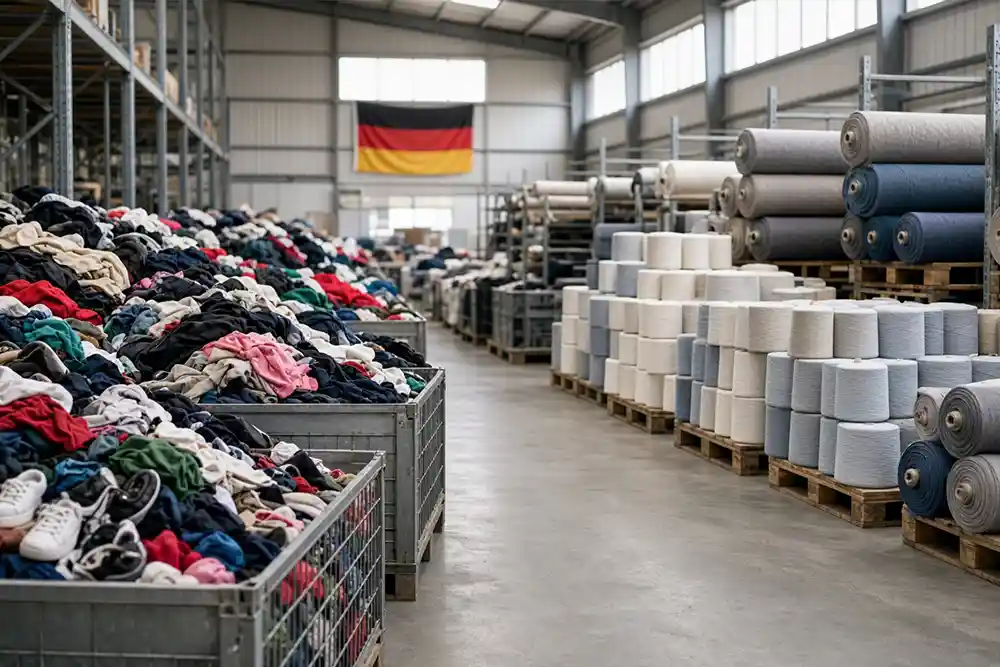
The new “Alliance for Textile Cycles” wants transparent fees, EU-wide harmonisation and equal treatment of non-EU online sellers as Germany prepares its mandatory textile and footwear EPR system.
Germany’s textile industry and retail sector have formed a joint alliance to influence the design of the country’s forthcoming Extended Producer Responsibility (EPR) regime for textiles and footwear, as implementation of revised EU waste rules moves closer.
The Confederation of the German Textile and Fashion Industry (textil+mode) and the German Retail Federation (HDE) launched the Allianz für textile Kreisläufe — Alliance for Textile Cycles — on August 26, 2026, inviting companies and other textile value-chain stakeholders to participate.
Producers will fund end-of-life costs
Under the revised EU Waste Framework Directive, producers placing textiles or footwear on a national market must finance collection and subsequent waste management, including sorting, preparation for reuse, recycling and disposal.
EU member states must establish textile EPR systems by April 17, 2028. Producer fees will eventually be eco-modulated according to sustainability factors such as durability and recyclability.
Germany is now preparing legislation to transpose those requirements. For the first time, companies placing textiles on the German market will be charged for their products’ eventual waste-management costs.
Industry wants a simpler architecture
The alliance is calling for mandatory industry participation in system design, transparent and causation-based cost allocation, a clearly defined system architecture and a legally robust, EU-harmonised scope.
A major concern is competitive neutrality. HDE argues that international marketplaces and sellers outside Europe must carry the same EPR obligations as German and EU companies when selling products into the market.
That issue is especially significant as cross-border direct-to-consumer fashion expands.
EPR becomes a product-cost variable
For brands and textile suppliers, EPR will increasingly turn durability, recyclability, fibre composition and end-of-life performance into financial variables, rather than sustainability metrics alone.
The EU rules also require national producer registers and producer-responsibility organisations, meaning companies selling across several European markets could face multiple reporting and fee systems.
The next critical issue is Germany’s legislative design: specifically, how fees will be calculated, how online imports will be enforced, and whether implementation remains sufficiently harmonised with neighbouring EU markets to avoid another layer of fragmented compliance.
