

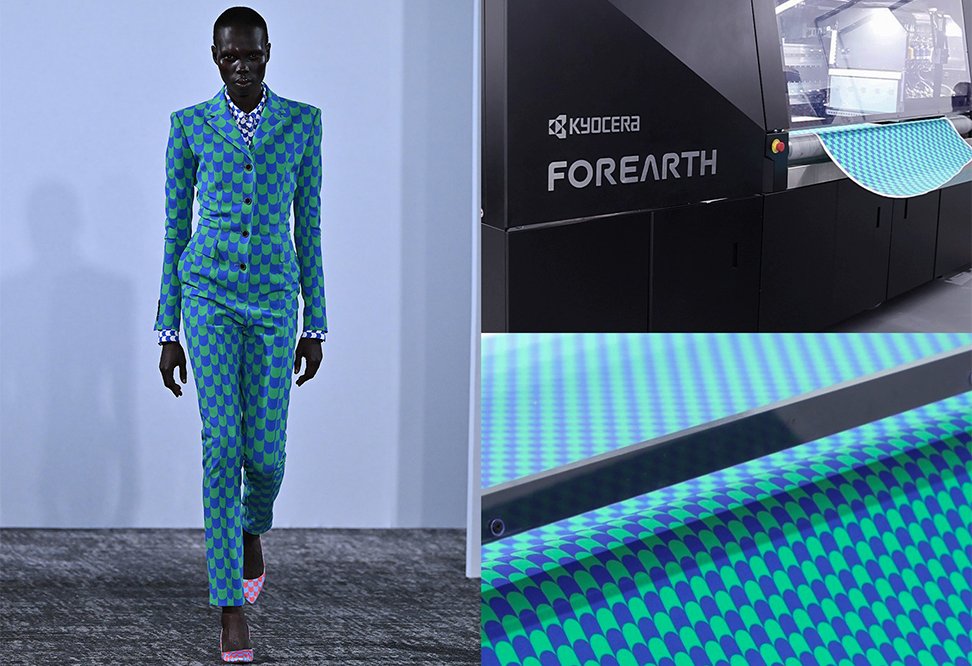
The collaboration showcases pigment printing on stretch fabrics, combining vivid graphics with a process designed to minimise water use.
Kyocera Document Solutions’ FOREARTH inkjet textile printer supplied printed fabrics for 27 of the 35 looks in ANREALAGE’s Spring/Summer 2027 collection, presented at Paris Fashion Week on September 29, 2026. Announced on October 2, the project marks the partners’ sixth consecutive seasonal collaboration.
Stretch fabrics put printing to the test
The collection, titled “SKIN”, used clothing as a second-skin concept, with graphics printed on highly stretchable materials. Fabrics included blends containing polyester, rayon and polyurethane, alongside experiments with the puckered surface of seersucker.
Designer Kunihiko Morinaga said pigment printing on elastic fabrics can produce stiffness or cracking. For this collection, he reported that FOREARTH’s printed surface stretched with the material. Kyocera also highlighted saturated blue, green and pink shades, sharp motifs and tonal gradations. These are project-specific observations rather than published comparative performance tests.
A shorter route from print to finished fabric
FOREARTH integrates printing and treatment chemistry into a workflow completed through printing and drying, removing the need for separate conventional pretreatment and post-treatment facilities.
Kyocera reports water consumption of 0.02 litres per kilogram of fabric, including equipment maintenance through a recirculating belt-cleaning system. Its May 2026 technical announcement compares this with up to 153 litres per kilogram for traditional dye printing. The figures are manufacturer-reported and concern the printing process, rather than the complete textile lifecycle.
Capability beyond the runway
The machine supports up to eight colours and a maximum printing width of 1,800mm, with applications spanning fashion, sportswear and home textiles. Compatible substrates include cotton, silk, polyester, nylon and blends. Its proprietary Picfy pigment ink carries ECO PASSPORT certification.
For commercial printers, the collection provides a reference for decorative printing on demanding stretch substrates. The next purchasing test is production economics: achievable throughput, ink and treatment costs, wash and rubbing fastness, and print durability under repeated extension. The announcement discloses neither machine pricing nor independent results for these measures.
