Roads, railways, drainage and climate-resilience projects are turning geotextiles into one of technical textiles’ most attractive infrastructure-linked growth markets.
The global geotextiles market could expand from $12.7 billion in 2025 to $37.4 billion by 2036, representing a 10.3% compound annual growth rate, according to Transparency Market Research (TMR). Rising transportation infrastructure, road rehabilitation and demand for more resilient civil-engineering systems are expected to drive growth.
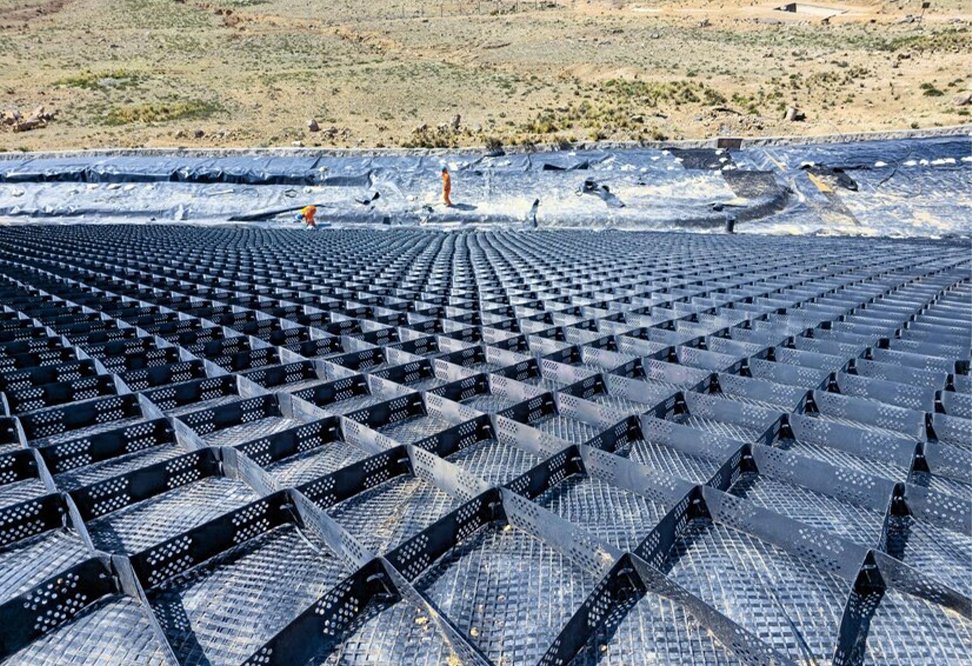
Geotextiles are permeable woven, nonwoven or knitted materials—typically produced from polypropylene or polyester—used with soil and aggregates to improve infrastructure performance.
Nonwovens take 57% share
TMR estimates nonwoven geotextiles accounted for 57% of the market in 2025, making them the dominant product category. North America represented about 32% of global revenue.
The materials perform several engineering functions, including separation, filtration, drainage, reinforcement and erosion control. The US Federal Highway Administration identifies applications beneath road bases, railway ballast, embankments and drainage systems, where geotextiles can prevent soil mixing, allow water movement and improve weak subgrade performance.
Industry growth is also expanding beyond conventional synthetic fabrics. TMR highlights increasing development of recycled-polymer and bio-based geotextiles, particularly for applications where lower environmental impact can be combined with defined engineering performance.
Pakistan opportunity
Geotextiles offer Pakistan a practical route into higher-value technical textiles because domestic infrastructure already consumes these materials. National Highway Authority schedules include 190-gsm and 320-gsm geotextiles, with one specification explicitly identifying imported 190-gsm continuous polypropylene nonwoven material.
Pakistan’s national planning documents also identify technical textiles as an area requiring investment, modern machinery and value-added manufacturing.
The opportunity is therefore to move from importing engineered fabrics toward producing certified road, drainage, filtration, erosion-control and reinforcement textiles locally. Success will depend less on conventional textile cost advantages than on polymer expertise, geotechnical design capability and compliance with tensile, puncture, permeability, opening-size and durability specifications.