

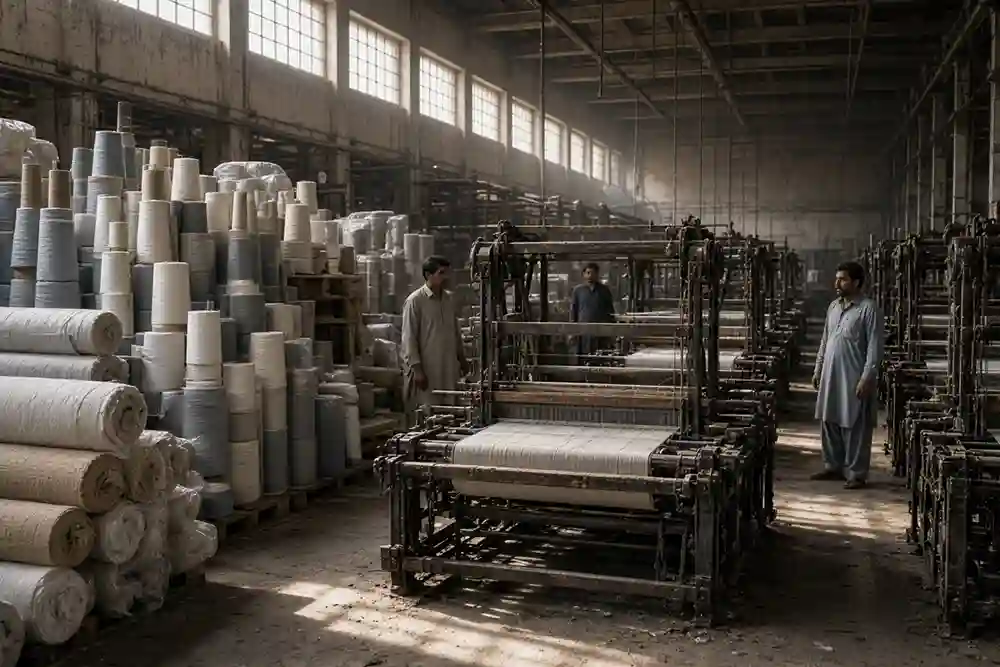
Pakistan’s downstream weaving sector is being squeezed between high domestic production costs and rapidly rising imports of yarn and fabric under the Export Facilitation Scheme.
Pakistan’s textile value chain is facing mounting pressure as industry representatives estimate that around half of power looms, more than 150 textile mills and roughly 500 ginning factories are currently inactive. The figures are industry claims rather than independently audited national capacity data, but separate reporting indicates serious disruption in the country’s largest textile cluster.
In Faisalabad and surrounding towns, around 40% of power-loom units have reportedly closed, with labour representatives estimating more than 100,000 job losses. The cluster contains nearly 800,000 power looms, ranging from small workshops to large weaving units.
Import pressure moves downstream
A central dispute concerns Pakistan’s Export Facilitation Scheme, which allows duty- and tax-free imports of inputs intended for export production.
APTMA says EFS imports of man-made yarn increased from 3,056 tonnes in FY2024-Q1 to 12,773 tonnes in FY2027-Q1, while man-made fabric imports jumped from 660 to 8,628 tonnes. The association argues that exports have not risen proportionately and has alleged diversion of some imported material into the domestic market.
Cotton-yarn imports fell 42% to 21,587 tonnes after that category was removed from the scheme, strengthening industry calls to similarly restrict yarn and fabric under Chapters 52 and 55.
Cotton supply offers little relief
Cotton arrivals reached 4.081 million bales by October 15, up 7.53% year on year. Punjab supplied 1.638 million bales and Sindh 2.443 million, while mills had purchased about 3.45 million bales.
The improvement in arrivals has therefore not translated into stronger utilisation across spinning and weaving.
Pakistan competitiveness takeaway
The deeper problem is a cost-and-policy mismatch across the textile chain. Exporters need competitively priced inputs, but unrestricted duty-free imports can weaken domestic spinning and weaving if compliance and end-use controls fail.
The policy challenge is therefore not simply to restrict imports. Pakistan needs credible EFS traceability, tighter customs valuation, competitive electricity, efficient tax refunds and stronger MMF capability.
A textile strategy that strengthens garments while hollowing out domestic spinning and weaving would weaken the very vertical integration that gives Pakistan its principal sourcing advantage.
