

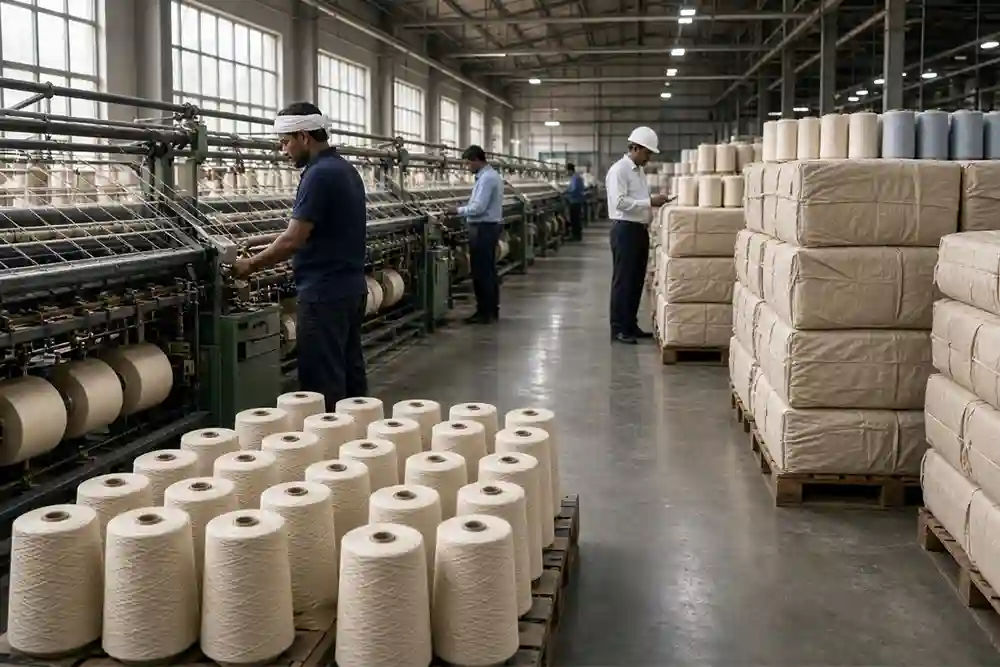
BTMA wants Bangladesh to protect domestic spinning without closing access to imported yarn, highlighting a growing policy tension between backward-linkage investment and garment-export competitiveness.
The Bangladesh Textile Mills Association has urged the government to retain tighter controls on imports of 10–30 count cotton yarn, arguing that policy should protect the country’s $32 billion primary textile industry while ensuring garment exporters retain access to competitively priced inputs.
Under the current system, export-oriented factories can still import affected yarn, but shipments covered by letters of credit opened after September 7, 2026 require bank guarantees equivalent to applicable duties and taxes instead of the traditional bonded-warehouse facility. The National Board of Revenue subsequently amended implementation rules in October.
Protection without an import ban
BTMA stresses that the measure does not prohibit yarn imports or introduce a new customs duty. Instead, the bank guarantee can be released after authorities verify that the imported yarn was used in exported goods and the export proceeds were repatriated.
The association argues that this could limit diversion of duty-free imported yarn into Bangladesh’s domestic market while creating fairer competition for local spinners.
Bangladesh’s primary textile sector includes 530 yarn mills, 1,012 fabric mills and 346 dyeing, printing and finishing units, according to BTMA.
Local content moves into the debate
BTMA also wants Bangladesh to restore a 30% local value-addition requirement for non-bonded industries importing raw materials against bank guarantees, eventually moving toward 40–60% local value addition after LDC graduation.
Garment associations have opposed tighter yarn controls, warning that additional procedures and financing costs could undermine sourcing flexibility and export competitiveness.
Competitiveness takeaway
Bangladesh’s debate offers an important lesson for Pakistan: backward integration and garment competitiveness must be managed together.
Protecting domestic spinning through administrative restrictions alone can raise downstream costs; unrestricted concessional imports can hollow out local capacity. The stronger model is transparent import traceability, efficient domestic mills, competitive energy and measurable local value addition.
For both countries, the policy objective should be to maximise competitive domestic value creation per exported garment—not simply minimise yarn imports or maximise local sourcing regardless of cost.
