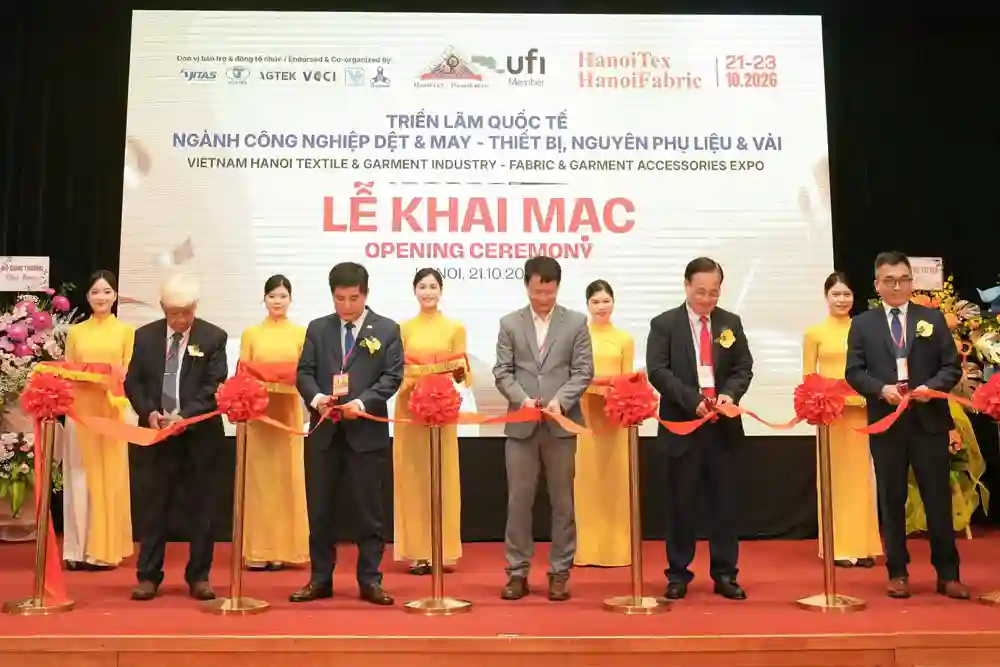
With textile and garment exports exceeding $36 billion in nine months, Vietnam is accelerating investment in weaving, dyeing, automation and domestic material production to strengthen its global competitiveness.
Vietnam’s HanoiTex–HanoiFabric 2026, held on October 21–23 in Hanoi, brought together more than 250 companies from eight countries and territories, showcasing textile machinery, advanced materials, automation and sustainable manufacturing technologies.
Covering over 6,000 square metres, the exhibition connected manufacturers with international technology suppliers as Vietnam prepares for another industrial investment cycle.
Exports Exceed $36 Billion
Vietnam’s textile and garment exports surpassed $36 billion during January–September 2026, increasing 3.3% year on year, according to Cao Huu Hieu, General Director of Vietnam National Textile and Garment Group (Vinatex).
The industry exported approximately $46.2 billion in 2025, representing 6% annual growth.
Vietnam’s textile and apparel sector comprises more than 14,300 enterprises employing 1.86 million workers.
Upstream manufacturing demonstrated stronger momentum, with textile industrial production increasing 10.2%, compared with 7.8% for apparel production.
Government Targets 60% Localisation
Vietnam is prioritising investment in spinning, weaving, dyeing, finishing and textile accessories to reduce dependence on imported intermediate materials.
Under Decision No. 929/QD-TTg, issued in May 2026, the government targets 60% localisation in textiles and garments by 2030, increasing to 70% by 2035.
Greater domestic material availability would help manufacturers meet trade-agreement rules of origin, improve supply-chain flexibility and capture more export value.
AI and Automation Take Centre Stage
Exhibitors presented robotics, 3D design, CAD/CAM systems, automated manufacturing equipment and new heat-transfer printing technologies.
Vietnam’s Ministry of Industry and Trade also highlighted AI applications in demand forecasting, fabric defect detection, pattern optimisation, predictive maintenance and production scheduling.
Energy-efficient machinery, emissions-reduction solutions and sustainable materials formed another major exhibition theme.
The Next Investment Cycle
Vinatex identified three priorities: expanding upstream production, modernising equipment and strengthening digital manufacturing systems.
For machinery suppliers, these priorities create opportunities in automated weaving, processing, quality inspection and factory management.
The key test will be whether Vietnam converts its localisation targets and technology partnerships into operational capacity, productivity gains and stronger domestic supply chains.