

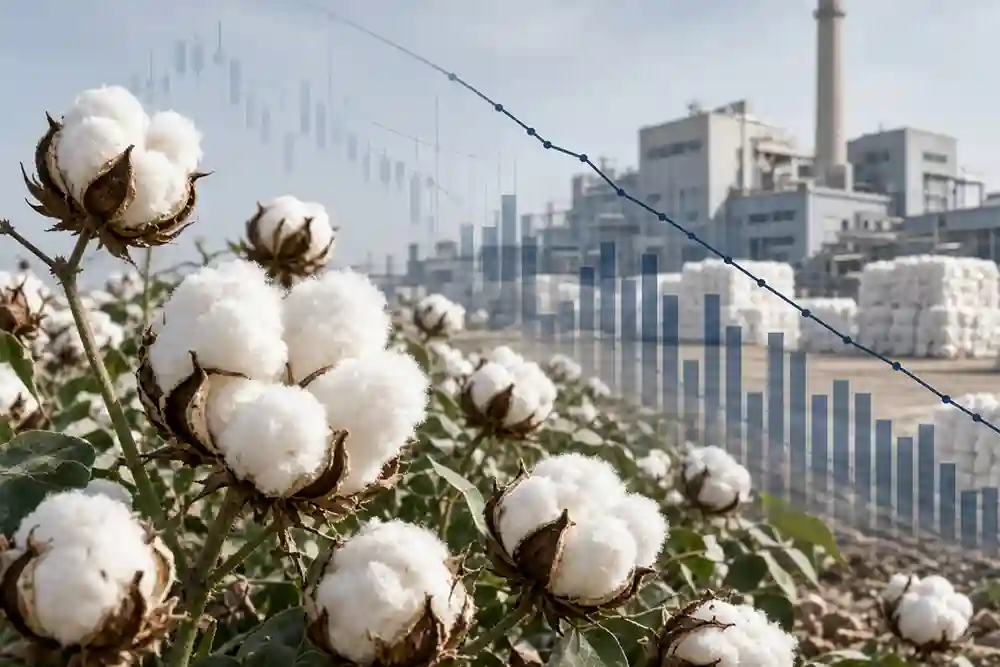
Cotton prices softened despite satisfactory trading activity, while higher seasonal arrivals and weak domestic textile demand continue to shape Pakistan’s cotton market.
Pakistan’s cotton spot rate declined by Rs100 to Rs18,000 per maund on October 23, 2026, reflecting continued softness in the domestic market despite satisfactory trading volumes.
According to cotton analyst Naseem Usman, the market maintained a relatively easy trading tone, with prices varying across major producing regions.
The latest reduction represents approximately 0.55% from the previous spot rate of Rs. 18,100 per maund.
Cotton Prices Across Producing Regions
Cotton prices in Punjab and Sindh ranged between Rs16,500 and Rs18,500 per maund, while seed cotton (phutti) traded between Rs7,000 and Rs9,000 per 40 kilograms.
In Balochistan, lint cotton prices ranged from Rs17,600 to Rs18,000 per maund, with phutti fetching Rs7,800–8,500 per 40 kilograms.
Meanwhile, polyester staple fibre was quoted at Rs445 per kilogram, providing an additional reference for spinning mills evaluating raw-material costs.
Cotton Arrivals Rise 7.53%
Pakistan’s cotton arrivals reached 4.081 million bales by October 15, increasing 7.53% from 3.796 million bales during the corresponding period last year, according to the Pakistan Cotton Ginners Association (PCGA).
Sindh accounted for 2.443 million bales, while Punjab contributed 1.638 million bales.
Textile mills had purchased approximately 3.452 million bales, while exporters and traders acquired 97,400 bales. Total unsold stocks, including unginned cotton, stood at 531,530 bales.
Spinning Mills Face a Mixed Market
Lower domestic cotton prices may offer some procurement relief for spinning mills, although actual savings depend on fibre quality, contamination, staple length and purchasing arrangements.
For growers and ginners, softer prices create pressure on margins and inventory values.
Meanwhile, official estimates place Pakistan’s 2026–27 cotton production at 6.7 million bales, below the original target of 9.64 million bales.
The next important signals will be late-season cotton arrivals, mill purchasing activity and international cotton prices. These will determine whether domestic prices stabilise or face further downward pressure.
