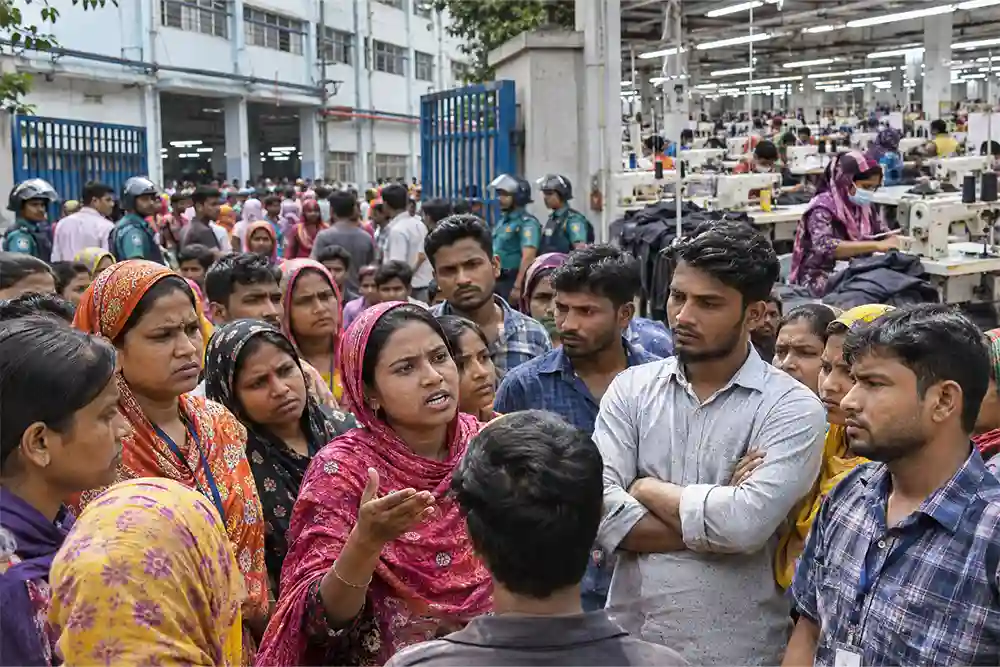
Garment workers are demanding a 140% increase in minimum wages to Tk30,000 per month, while manufacturers warn that rising labour costs and factory disruptions threaten export competitiveness.
Bangladesh has established a six-member minimum wage board to review garment workers’ salaries after widespread protests disrupted operations at 529 factories, affecting 987,190 workers on November 1, 2026.
The unrest, concentrated in Dhaka, Gazipur, Mymensingh and Savar-Ashulia, has disrupted production and transport across major manufacturing centres, raising concerns over export delivery schedules.
Workers Demand 140% Wage Increase
Garment workers are demanding a minimum monthly wage of Tk30,000 ($245), compared with the existing Tk12,500, citing rising food, housing, transport and healthcare costs.
The current minimum wage was introduced in December 2023, increasing pay from Tk8,000.
Under Bangladesh’s amended labour legislation, minimum wages must now be reviewed every three years instead of five.
Labour and Employment Minister Ariful Haque Choudhury announced the board’s formation following discussions with worker representatives and industry associations, including BGMEA and BKMEA.
Chaired by Senior District and Sessions Judge Sheikh Ashfaqur Rahman, the board includes government-appointed, independent, employer and worker representatives.
Factory Closures Threaten Export Deliveries
According to BGMEA, disruptions affected 276 factories in Gazipur and Mymensingh, 185 in Savar-Ashulia and 68 in Dhaka’s Mirpur area.
Protesters blocked major roads, while clashes with police prompted the use of tear gas and water cannon.
Bangladesh’s garment industry employs approximately four million workers, contributes around 10% of GDP and generates more than 80% of export earnings.
Manufacturers argue that sharply higher wages could further squeeze margins already affected by production costs, energy shortages and international competition.
Wage Settlement Remains Uncertain
The government has urged workers to resume operations while the board evaluates revised pay rates.
However, establishing the board does not constitute approval of the Tk30,000 demand.
For international apparel buyers, prolonged disruptions could affect shipment reliability and sourcing schedules.
The immediate test is whether wage negotiations restore industrial stability while producing an affordable, credible salary structure. The board’s recommendations, implementation timetable and manufacturers’ ability to absorb additional labour costs will determine the commercial impact.