

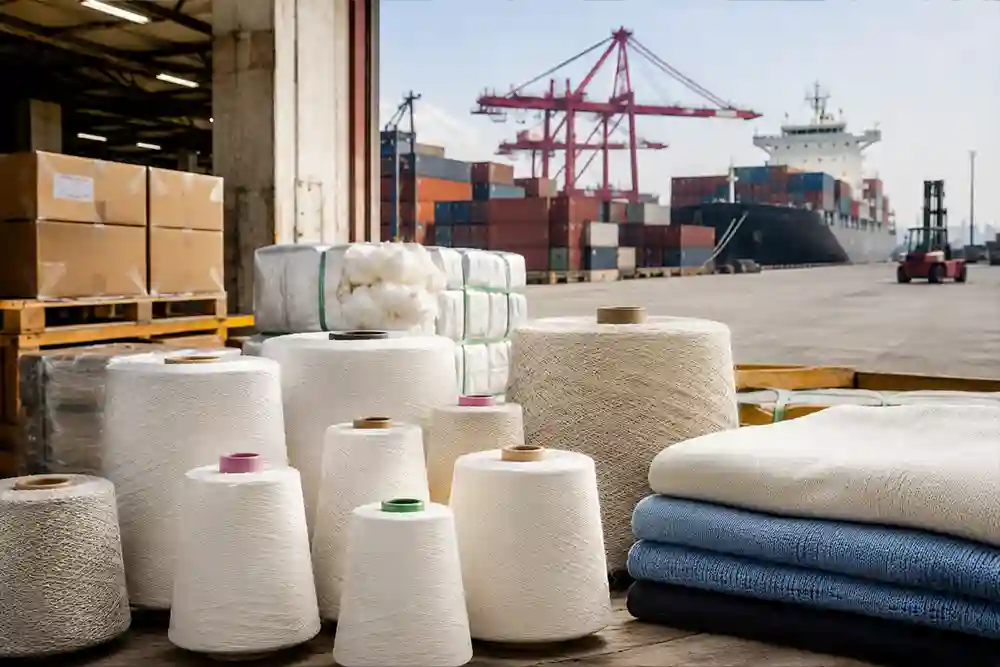
China’s cotton yarn exports recovered in September as demand strengthened in Vietnam and Cambodia, although declining Pakistani purchases and weaker demand for fine-count yarns continued to weigh on the market.
China exported 19,500 metric tonnes of cotton yarn in September 2026, an increase of 20.94% from August but just 0.19% above September 2025, according to customs data analysed by CCF Group.
The improvement marked the first year-on-year increase since mid-2026. However, cumulative exports during January–September declined 13.81% to 146,800 tonnes, indicating that the broader recovery remains fragile.
Pakistan Remains Largest Buyer Despite Sharp Decline
Pakistan accounted for 31.58% of China’s September cotton yarn exports, equivalent to approximately 6,160 tonnes.
However, shipments to Pakistan fell 33.74% year on year, reducing its share by 16.17 percentage points.
Other Asian markets showed contrasting trends:
- Vietnam: Exports increased 24.69%.
- Cambodia: Shipments increased 34.89%.
- Bangladesh: Exports declined 2.45%.
Pakistan, Vietnam and Bangladesh together absorbed approximately 11,700 tonnes, representing 60.2% of China’s total cotton yarn exports.
Demand Shifts Towards Coarser Cotton Yarns
China’s export composition also changed significantly.
Three major combed yarn categories—54.8–66s, above 66s and 30.4–46.6s—accounted for 10,110 tonnes, or 51.98% of September exports.
Their combined share declined by 14.08 percentage points from a year earlier.
Demand for lower-count yarns improved, with combed 8.2–25s exports increasing 103.5%, while combed ply yarns in the same count range grew 33.8%.
Conversely, combed 54.8–66s shipments declined 36.7%.
Implications for Pakistan’s Spinning Industry
China’s reduced yarn shipments to Pakistan could reflect changes in sourcing patterns, competitive pricing or demand, but the figures do not establish the causes.
Interestingly, China simultaneously imported 195,600 tonnes of cotton yarn in September, up 69.13% year on year, highlighting substantial differences between its import and export markets.
For Pakistani spinning mills, the critical indicators are domestic yarn demand, imported-yarn prices and the competitiveness of locally produced counts.
The next test will be whether China’s fourth-quarter yarn exports sustain their recovery and whether Pakistani purchases stabilise.
