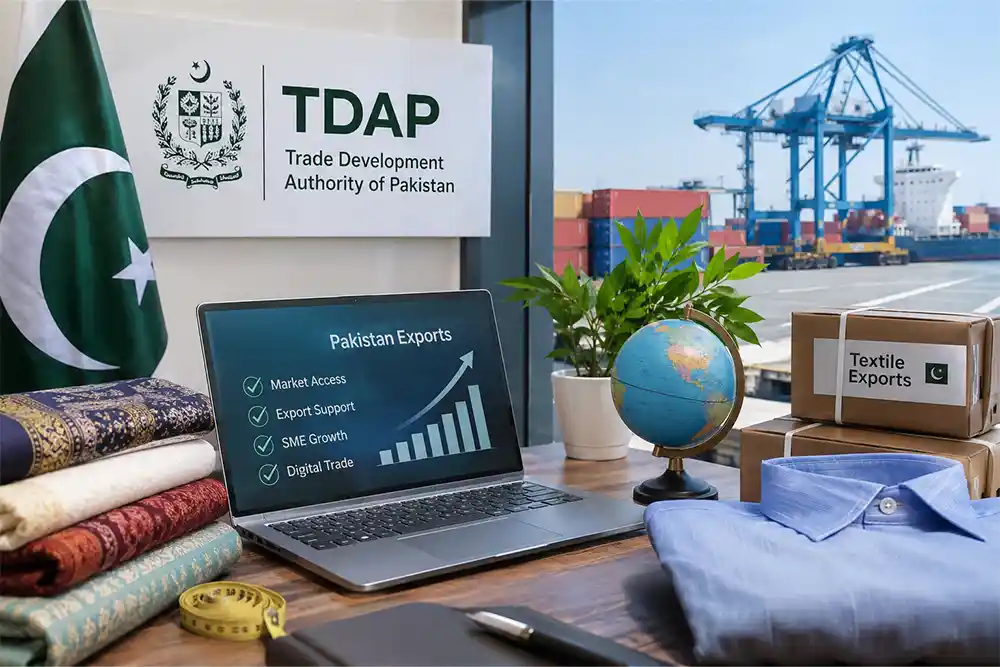
Prime Minister Shehbaz Sharif has approved restructuring Pakistan’s trade promotion authority, introducing eight core functions, AI-powered services and independent performance monitoring, with reforms targeted for completion by mid-2027.
Pakistan has approved a major restructuring of the Trade Development Authority of Pakistan (TDAP) to improve export competitiveness, expand international market access and strengthen support for manufacturers and small and medium-sized enterprises (SMEs).
The decision was taken at a high-level meeting chaired by Prime Minister Shehbaz Sharif in Islamabad on November 6, 2026, following a review of TDAP’s institutional structure, operational challenges and performance.
Eight Core Functions and Digital Transformation
The reform package proposes concentrating TDAP’s mandate into eight core functions, restructuring its board and management, and strengthening its regional offices.
Digital platforms and artificial intelligence will be introduced to improve trade promotion operations and exporter services.
The proposed structure draws on international trade promotion agencies that integrate market development, overseas buyer engagement, exporter capacity building and commercial facilitation.
Specific functions, technology budgets and implementation arrangements have not yet been disclosed.
Performance-Based Management and Independent Audits
The government plans to introduce measurable performance indicators and independent third-party evaluations to assess TDAP’s effectiveness.
Sharif directed that professional recruitment follow merit-based procedures, with employee advancement linked to demonstrated performance and achievement of institutional targets.
He also ordered the appointment of a reputable private audit firm to conduct financial and performance audits.
A 12-month implementation roadmap covering approval, design, execution and independent evaluation was presented, although the prime minister directed completion by mid-2027.
Implications for Pakistan’s Textile Exporters
For textile and apparel manufacturers, a modernised TDAP could strengthen international buyer connections, export-market intelligence and support for meeting overseas product and compliance standards.
SMEs could particularly benefit from more accessible market-entry services and digital trade promotion.
However, the reforms do not directly address energy tariffs, financing costs or manufacturing productivity.
The immediate test will be publishing a detailed implementation plan with measurable export outcomes. Success should ultimately be assessed through new buyers secured, market diversification, SME export participation and realised export orders rather than institutional restructuring alone.