

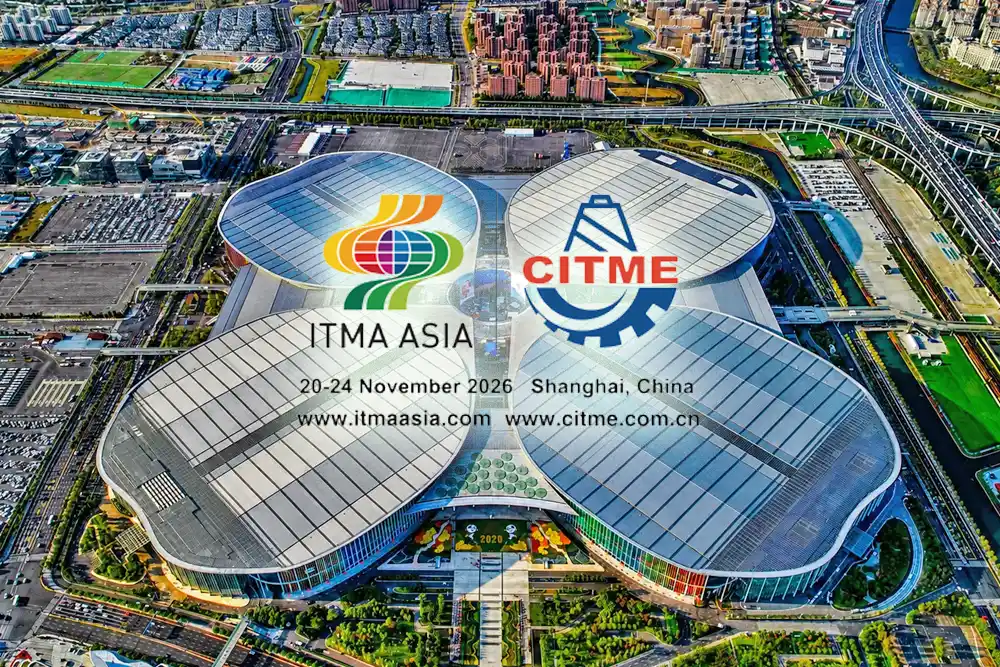
The largest edition in the exhibition’s history will bring together global textile machinery manufacturers, highlighting artificial intelligence, automation, digitalisation, resource efficiency and technologies reshaping textile production.
ITMA ASIA + CITME 2026 will bring the international textile machinery industry to Shanghai from November 20–24, 2026, positioning intelligent manufacturing, automation and sustainability at the forefront of technological innovation.
The 10th combined exhibition, taking place at the National Exhibition and Convention Centre (NECC), will occupy approximately 180,000 square metres across seven halls, making it the largest edition in the event’s history.
According to organisers, more than 1,800 companies had applied to participate, with Chinese manufacturers accounting for almost 90% of applicants. The exhibition comes as textile producers worldwide face rising operating costs, workforce challenges, changing sourcing patterns and increasing demands for environmentally responsible manufacturing.
Artificial Intelligence and Automation Transform Textile Production
Artificial intelligence, robotics and digital manufacturing technologies will feature prominently at the exhibition, reflecting the industry’s transition towards connected and data-driven factories.
New exhibition categories will highlight industrial robots, intelligent sensing, digital twins, automated production systems and virtual commissioning.
A dedicated Research and Innovation sector will showcase developments from Chinese universities and research organisations, including intelligent inspection systems and AI-powered manufacturing applications.
These technologies offer opportunities to improve production scheduling, detect fabric defects, predict machinery failures and minimise material waste.
Santoni China Group will demonstrate its SWS 3D AI-assisted design platform alongside digitally integrated knitting technologies.
Picanol will showcase developments within its PicConnect digital ecosystem, including AI-supported applications designed to improve weaving performance and operational decision-making.
However, successful adoption will depend on reliable production data, machinery connectivity, workforce training and measurable financial returns.
Spinning and Weaving Innovations Target Higher Productivity
Leading machinery manufacturers will introduce technologies addressing productivity, material utilisation and operational efficiency.
Trützschler will highlight its TC 30 card, which the company claims can achieve up to 40% higher productivity in man-made fibre processing.
Its T-CAN automated can transport system aims to reduce manual material handling, while fibre-recovery technologies support improved raw-material utilisation.
Savio will present its Proxima Smartconer winding platform and Lybra Smartspinner air-jet spinning technology, emphasising automation, production intelligence and manufacturing flexibility.
In weaving, Picanol will introduce its AirOne air-jet machine, designed for efficient basic-fabric production, alongside the OmniPlus-i Connect and Supermax platforms.
KARL MAYER will showcase its WARPDIRECT 2.0 warping machine, capable of operating at speeds up to 1,200 metres per minute, together with advanced sizing technologies.
These developments demonstrate the industry’s increasing emphasis on consistent quality, reduced downtime and lower production costs rather than machinery speed alone.
Knitting and Finishing Focus on Innovation and Sustainability
Knitting machinery manufacturers will demonstrate technologies supporting complex fabric structures, higher-value applications and more flexible production.
Santoni China Group will present innovations across its Santoni, Jingmei and Terrot brands, targeting seamless garments, advanced jacquard structures and performance textiles.
KARL MAYER will introduce warp-knitting developments offering improved design flexibility, finer fabric constructions and technical applications.
In textile processing, energy efficiency, heat recovery, chemical optimisation and reduced water consumption will remain critical priorities. Manufacturers are increasingly seeking integrated solutions that minimise processing losses while maintaining consistent fabric quality.
Preventing defects at earlier manufacturing stages can also deliver significant environmental benefits by avoiding unnecessary downstream processing.
Recycling and Technical Textiles Expand Market Opportunities
Textile recycling and advanced composite technologies will receive increased attention as manufacturers explore circular production and new industrial applications.
A new composites sector will feature technologies including multiaxial warp knitting, advanced weaving and three-dimensional textile reinforcement.
Potential applications include automotive lightweighting, aerospace components and high-performance industrial materials.
Recycling technologies will address growing demand for recovered fibres, although manufacturers must overcome challenges involving contamination, fibre consistency, equipment wear and commercial scalability.
The exhibition will also highlight opportunities in medical textiles, filtration, protective materials and automotive applications.
Strategic Opportunities for Pakistan’s Textile Industry
For Pakistan, ITMA ASIA + CITME 2026 offers an important opportunity to evaluate machinery solutions capable of improving international competitiveness. Pakistan’s textile manufacturers continue to face challenges involving energy costs, raw-material efficiency, production reliability and increasing customer expectations.
Spinning mills can explore technologies improving fibre utilisation and automation, while weaving manufacturers can assess solutions supporting higher efficiency and fabric quality.
Processing companies will have opportunities to evaluate energy-saving machinery, advanced finishing systems and technologies reducing water and chemical consumption.
For Pakistani investors, purchasing decisions should consider total operating costs, maintenance support, workforce requirements and realistic investment payback periods.
The Future Belongs to Intelligent Manufacturing
ITMA ASIA + CITME 2026 will demonstrate the growing convergence of machinery engineering, artificial intelligence, automation and sustainable production. Nevertheless, manufacturers’ performance claims will require evaluation under actual industrial operating conditions.
The exhibition’s significance will ultimately extend beyond new machinery launches. Its central message is that future competitiveness will depend on integrated manufacturing systems combining productivity, digital intelligence, operational flexibility and responsible resource management.
For textile manufacturers across Asia and beyond, Shanghai will provide an important opportunity to assess the technologies shaping the industry’s next phase of industrial transformation.
