

Stratview Research identifies fishing rods as the largest application, bicycles as the fastest-growing segment and Asia-Pacific as the principal manufacturing market, although its headline growth figures require clarification.
The global market for carbon fibre used in sporting goods is forecast to reach $716 million by 2030, according to a Stratview Research study covering fishing equipment, bicycles, golf shafts, racquets and winter-sports products.
The report, originally published in May 2024, estimates the market at $294 million in 2023. Its outlook reflects demand for lightweight, stiff and high-strength composites that improve equipment performance.
Fishing Rods Lead; Bicycles Accelerate
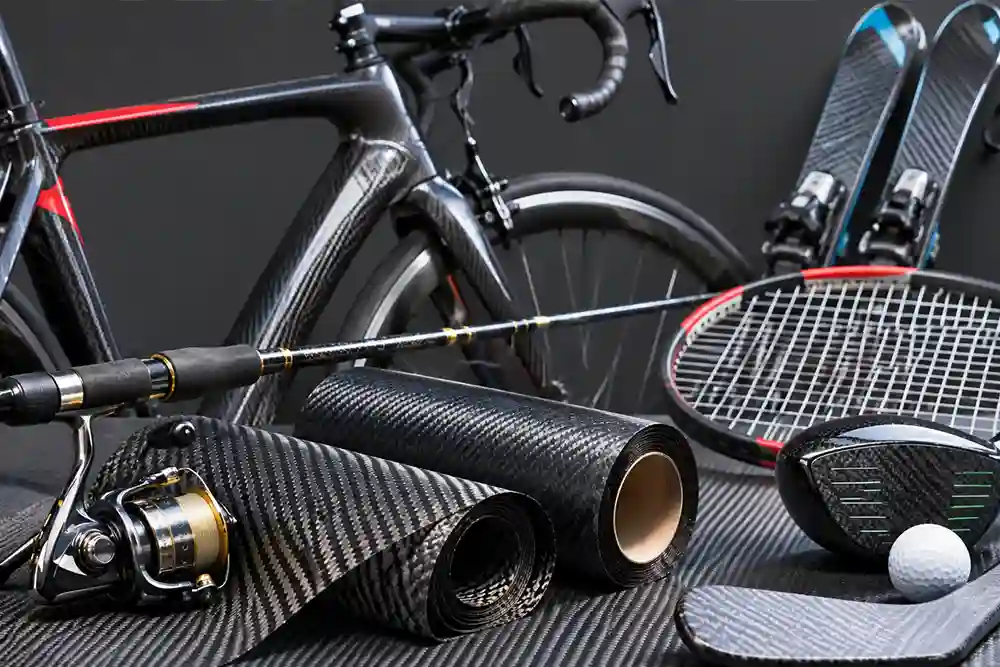
Fishing rods are expected to remain the largest application, supported by carbon fibre’s low weight, stiffness and sensitivity.
Bicycle frames and forks represent the fastest-growing application, with demand linked particularly to Europe and North America.
Golf shafts, hockey sticks, racquets and ski poles provide additional markets for specialised fibres and composite components.
Prepregs Dominate Material Processing
Standard-modulus carbon fibre is expected to retain the largest share, while prepreg—fibre reinforcement pre-impregnated with resin—is the predominant material format.
Roll wrapping remains the leading manufacturing process, particularly for tubular products such as fishing rods and golf shafts.
Stratview identifies bladder moulding as the fastest-growing process, reflecting demand for shaped hollow composite components.
These applications offer opportunities for carbon fibre producers, technical textile manufacturers and composite processors.
Asia-Pacific Remains the Production Centre
Asia-Pacific dominates the market, with China the principal manufacturing base. Europe is projected to achieve the fastest regional growth.
Leading suppliers include Toray Industries, Mitsubishi Chemical, Teijin, Zhongfu Shenying, Hexcel and SGL Carbon.
However, the published forecast contains a significant inconsistency. Its stated 3.1% compound annual growth rate does not reconcile with growth from $294 million in 2023 to $716 million in 2030. Those figures imply approximately 13.6% annual growth.
For manufacturers and investors, the next priority is clarifying the market forecast while assessing fibre costs, production scalability, manufacturing efficiency and demand for premium composite sporting goods.
