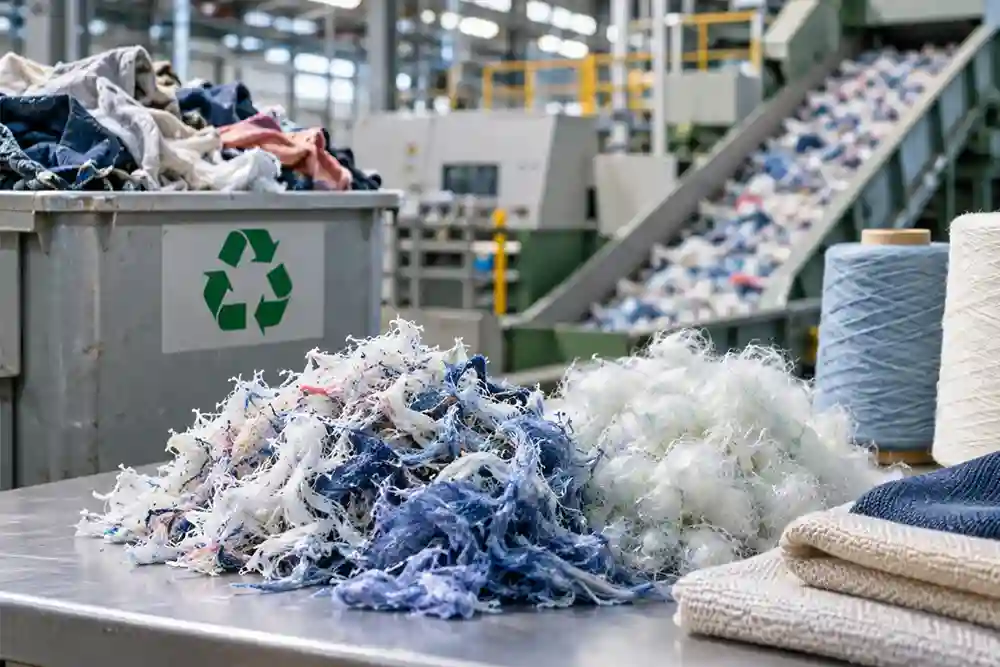
The European Commission’s Joint Research Centre has proposed common criteria for determining when recycled textile materials can legally cease being classified as waste, potentially removing barriers to circular textile manufacturing.
The European Commission’s Joint Research Centre (JRC) has published technical proposals for EU-wide end-of-waste criteria for textile recycling, seeking to harmonise how recycled materials are classified, verified and traded across the European Union.
Published on October 27, 2026, and highlighted by the Commission’s Textiles Ecosystem Platform on November 12, the report addresses regulatory fragmentation that complicates recycling operations and discourages investment.
Four Recycling Technologies Covered
The proposals cover mechanical, thermo-mechanical, physical and chemical recycling, including combinations of these technologies.
Eligible feedstocks include industrial textile waste, pre-consumer waste and separately collected post-consumer textiles unsuitable for reuse.
Natural and synthetic fibres, including blends, fall within the proposed scope. Energy-recovery processes and fuel production are excluded.
Five Conditions for Recycled Materials
The JRC proposes requirements covering five areas: input materials, recycling processes, output quality, quality assurance and documentation.
Recyclers would need to demonstrate appropriate sorting, contamination control and compliance with applicable chemicals legislation, including REACH.
Recovered materials must also satisfy relevant product standards and customer specifications.
A documented quality management system would cover incoming waste, processing, sampling, testing and records.
Independent verification would occur every three years, while each qualifying consignment would require a statement of conformity retained for at least three years.
Commercial Implications for Textile Supply Chains
Harmonised criteria could reduce uncertainty over whether recycled fibres, yarns and other recovered materials can be marketed as products rather than regulated waste.
For recycling companies and textile manufacturers, this could simplify cross-border transactions, strengthen buyer confidence and support investment in recycling capacity.
Suppliers would nevertheless need reliable feedstock records, chemical-compliance evidence, process documentation and material-quality testing.
The proposals are not binding EU law. Developed under Article 6 of the Waste Framework Directive, they provide a technical basis for possible future legislation.
The next decision rests with the European Commission, which has not committed to adopting the recommendations. Any eventual implementing act could differ from the JRC proposals.