


The widening gap with Vietnam is less a simple price problem than a warning about product mix, value addition and exporters’ bargaining power.
Bangladesh’s average apparel export unit value to the European Union fell 8.47% year on year to €13.80 per kg in January–July 2026, less than half Vietnam’s €29 per kg, according to Eurostat-based trade data. Vietnam’s unit value increased 11.76%, highlighting sharply different trajectories among two major Asian sourcing hubs.
The comparison needs an important qualification: unit value per kilogram is not the price of an identical garment. It is heavily influenced by each country’s export mix, including product complexity, fibre type, garment weight and finishing. Bangladesh Knitwear Manufacturers and Exporters Association president Mohammad Hatem attributes much of the difference to Bangladesh’s concentration in basic, high-volume garments versus Vietnam’s larger share of higher-value products.
Bangladesh falls below the EU average
The EU’s overall apparel import unit value was €19.84/kg, meaning Bangladesh traded at roughly 30% below the market average. Cambodia reached €18.67/kg, while Turkey achieved €28.31/kg. Pakistan was lower still at €10.77/kg, after a 14.74% year-on-year decline.
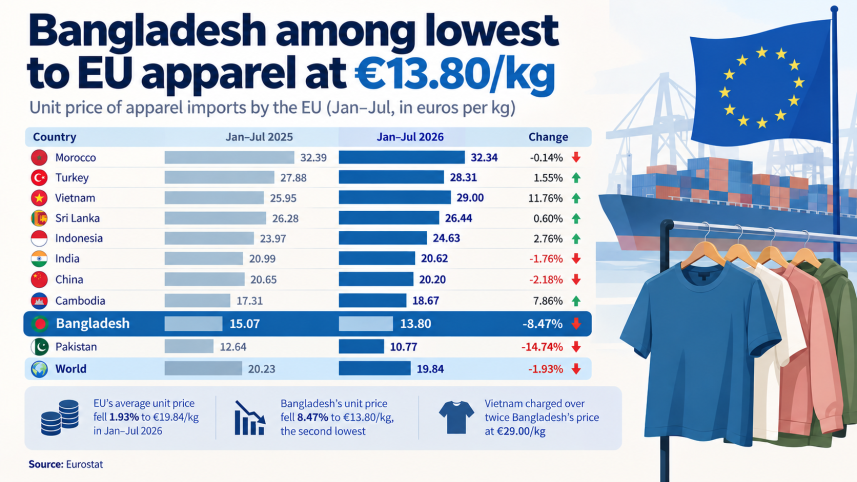
Lower prices did not protect Bangladesh from weaker demand. Its EU apparel exports fell 13.65% to €10.37 billion in January–July, while volume declined only 5.66% to 751.91 million kg—showing that falling unit values amplified the revenue decline. Vietnam, by contrast, increased EU export value 3.92% to €2.55 billion while raising average prices.
Moving beyond basics becomes urgent
Bangladesh has started easing import procedures for specialised fabrics used in products including seamless sportswear, underwear and functional garments, potentially supporting movement into more technically demanding categories.
The strategic issue extends beyond Bangladesh. For exporters competing primarily on basic cotton garments, including Pakistan, the data underline the limits of volume-led competition. Higher unit values will increasingly depend on MMF capability, performance fabrics, specialised finishing, product development, shorter lead times and direct engagement with brands.
The next indicator to watch is whether Bangladesh’s recent input-policy reforms translate into a measurable shift in its EU product mix—and eventually into higher export value per kilogram.
