

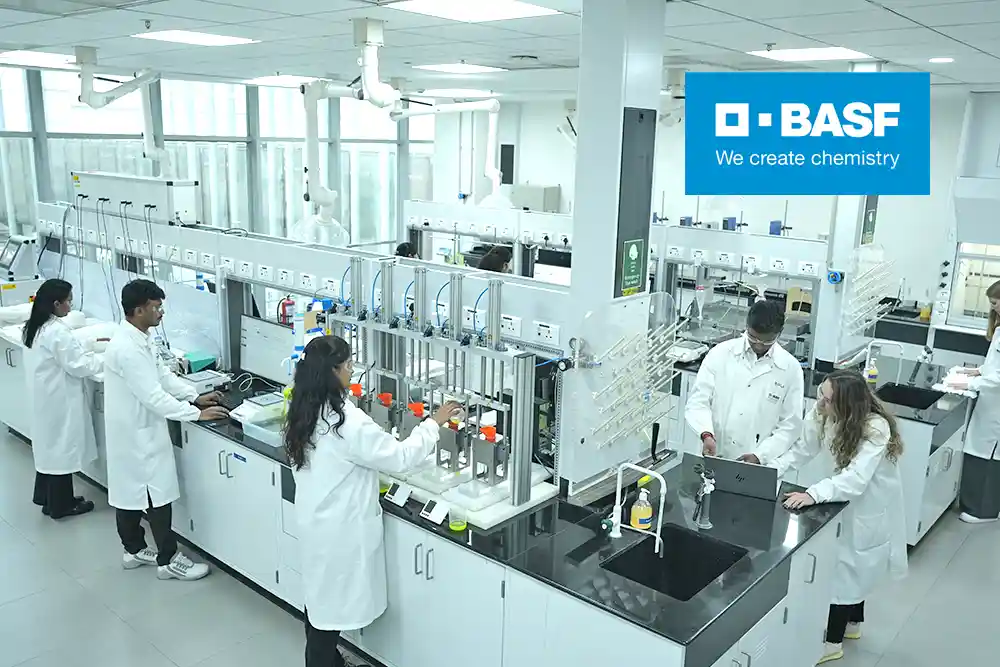
The 200-square-metre facility can run more than 30 test methods, giving hygiene manufacturers faster access to diaper benchmarking, SAP evaluation and application development in one of Asia’s largest growth markets.
BASF has opened a new global Performance Lab for diapers and superabsorbent polymers (SAP) in Mumbai, India, expanding its technical-service infrastructure for the disposable hygiene industry. The facility was inaugurated on August 18, 2026 and will serve customers globally from BASF’s Innovation Campus Asia Pacific in Mumbai.
The campus, established in 2017, is BASF’s second-largest R&D site in Asia-Pacific. The new laboratory was completed in less than a year under BASF Chemicals India and forms part of the company’s Hygiene Solutions business.
More than 30 performance tests
The laboratory covers approximately 200 square metres and is equipped to conduct more than 30 testing methods covering both superabsorbent polymers and finished diaper performance.
Capabilities include product characterisation, diaper benchmarking, microscopic SAP evaluation, run-off testing and Rewet Under Load measurements. The facility is intended to support joint development with manufacturers serving baby diapers, adult incontinence products and feminine hygiene applications.
SAPs are critical components of absorbent hygiene cores because they can absorb and retain substantial quantities of liquid even under pressure. Their performance affects leakage protection, dryness, product thickness and consumer comfort. BASF markets superabsorbents including HySorb and SAVIVA for hygiene applications.
India gains a larger R&D role
The Mumbai operation will work with BASF’s existing Global Product Development Lab for superabsorbents in Ludwigshafen, Germany, connecting application testing in Asia with the group’s wider product-development network.
For hygiene and nonwoven producers, the commercial value lies in shortening the development loop between SAP chemistry, absorbent-core design and finished-product performance. Faster benchmarking can help manufacturers optimise polymer dosage, core construction and performance-to-cost ratios before moving into full production.
The next measure of the investment’s impact will be how extensively BASF uses Mumbai for customer co-development and whether the facility accelerates new SAP formulations aimed at thinner products, improved liquid management, lower material use and better environmental performance.
