

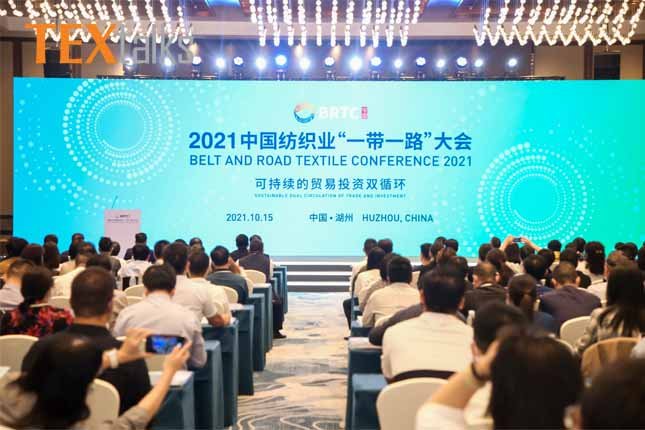
The Belt and Road Textile Conference 2021 was held in Huzhou, Zhejiang province on October 15, which saw the participation of government officials from ministerial and local levels, and representatives from the China National Textile and Apparel Council (CNTAC), foreign government agencies, and business associations, and industry-leading companies. Themed on “Sustainable Dual Circulation of Trade and Investment”, the conference aimed to accelerate the integration of domestic and international trade with a focus on increasing domestic demands, assess policy trends for industry growth, and launch insightful guidelines.
The Belt and Road Textile Conference 2021 was guided by CNTAC and the Huzhou Municipal People’s Government, and hosted by the Sub-Council of Textile Industry of China Council for the Promotion of International Trade (CCPIT TEX), China Textile Go Global Union (hereinafter referred to as the Union), and CCPIT Huzhou Committee.
Xu Yingxin, Vice Chairman of CNTAC and Chairman of CCPIT TEX, stated in his welcome speech that this year marked the 8th anniversary of the Belt and Road Initiative (BRI). Since its launch in 2013, the initiative has become one of the largest platforms for international cooperation with the most countries involved, bringing huge opportunities and dividends to all countries in the world. As the world is undergoing profound changes unseen in a century, the outbreak of COVID-19 has accelerated changes to the global landscape. In such a complex and volatile era, all countries are bound to share weal and woe.
One of the options that can benefit all countries is making committed efforts to pursue high-quality progress in the BRI and strengthen amicable relations and cooperation between China and its neighbors to deliver more opportunities and benefits.
Gao Yong, Secretary-General of China National Textile and Apparel Council, gave a keynote speech on “A New Era Leading to a Sustainable Dual Circulation of Trade and Investment in Textile Industry”.
Mr. Gao observed that the textile industry has witnessed extraordinary outbound investments and cooperation in the past two years despite the heavy blow dealt by the COVID-19 and that the industry has managed to resume work and production despite challenging circumstances. He also analyzed challenges lying ahead that were brought by the pandemic and the new development pattern. He appealed to all the industry actors to work towards a safe, stable and sustainable future for the sector.
Mr. A. Sukumaran, Chairman of the Joint Apparel Association Forum (JAAF) in Sri Lanka, shared his insights into trade and investment opportunities of the country’s textile and apparel industry via video link. He began with an introduction to JAAF. According to him, exports of the local textile and apparel industry totaled 5.6b USD in 2019, making it the largest export industry in Sri Lanka.
42% of the imported fabric comes from China, the biggest supplier for Sri Lanka, with the trade volume totaling 968m USD. The United States, the European Union, and the United Kingdom are major trading partners for Sri Lanka’s exports.
As to investment advantages in Sri Lanka, Mr. Sukumaran mentioned the high ease of doing business, world-class manufacturing facilities/services, a capable and flexible labor force, as well as preferential market access in the EU and the UK.
He observed that looking ahead, the textile and apparel industry in Sri Lanka will strengthen backward integration, and work with more foreign governments to maintain and improve export market access, so as to expand into more markets and bring itself to a new level.
The Belt and Road Textile Conference 2021 offered excellent speeches on and insights into the sustainable dual circulation of trade and investment and served as a platform for industry stakeholders to discuss new paths towards more diverse and higher-quality growth.
All players in the textile industry are well-prepared and determined to embark on a new journey towards high-quality growth.

