

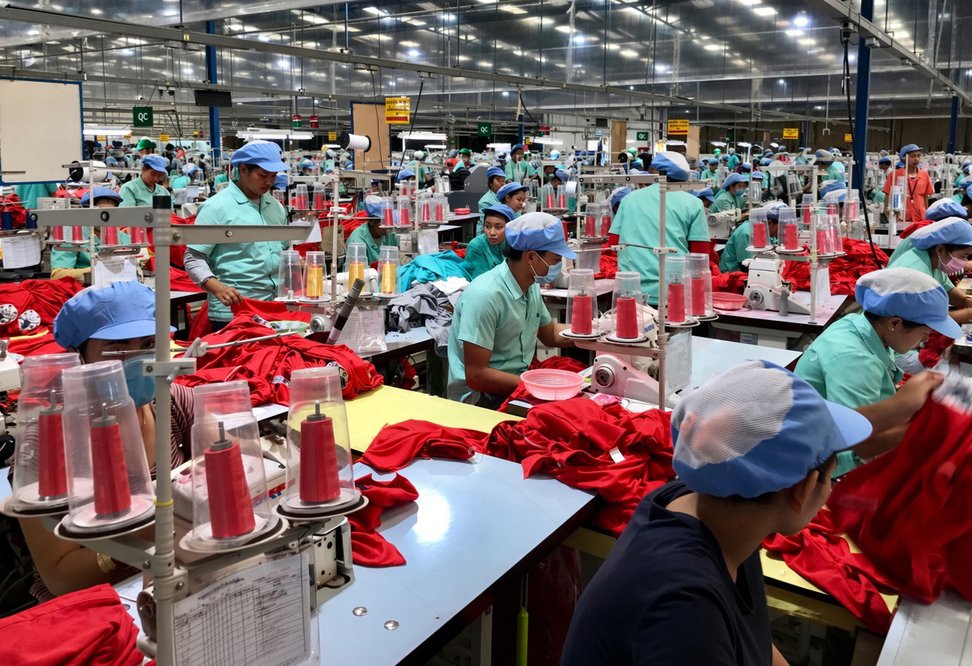
Cambodia is gaining apparel business even as demand weakens in some major markets, reinforcing its position as one of Asia’s fastest-growing garment sourcing locations.
Cambodia exported nearly $7 billion of garments and clothing accessories during January–July 2026, an increase of almost 8% year on year, according to data from the General Department of Customs and Excise cited by the Phnom Penh Post. Garments alone accounted for roughly one-third of Cambodia’s total exports during the period.
The performance extends the momentum recorded in the first half, when exports from Cambodia’s broader garment, textile, footwear and travel-goods sector reached $7.99 billion, up 6.2% from $7.52 billion a year earlier.
Export growth outpaces global demand
Cambodia’s results are notable because apparel demand in the United States has weakened. US apparel imports fell 7.7% year on year to $35.08 billion during January–June 2026, yet shipments from Cambodia increased 12.6% to $2.13 billion, the strongest percentage growth among major Asian suppliers.
The wider Cambodian export economy is also expanding rapidly. Total merchandise exports reached about $20.81 billion in the first seven months, up 21.3%, while overall trade climbed to $44.07 billion.
Scale continues to build
Cambodia’s garment, footwear and travel-goods manufacturing base now includes more than 1,800 factories and branches employing around 1.1 million workers, underlining the sector’s importance to employment and foreign-exchange earnings.
The industry benefits from established access to the US, EU, Canada and Japan, while investment from Asian manufacturers continues to expand capacity. However, Cambodia still relies heavily on imported yarns, fabrics and other inputs, limiting the share of export value retained domestically.
The next competitive step
For international buyers, Cambodia’s latest numbers indicate that sourcing diversification away from more concentrated Asian supply bases is continuing.
The strategic challenge for Cambodia is now to convert rising garment orders into greater domestic value addition through spinning, weaving, knitting, dyeing and finishing. If upstream investment develops alongside apparel capacity, Cambodia could evolve from a predominantly cut-and-sew location into a more integrated textile and garment sourcing hub.
