

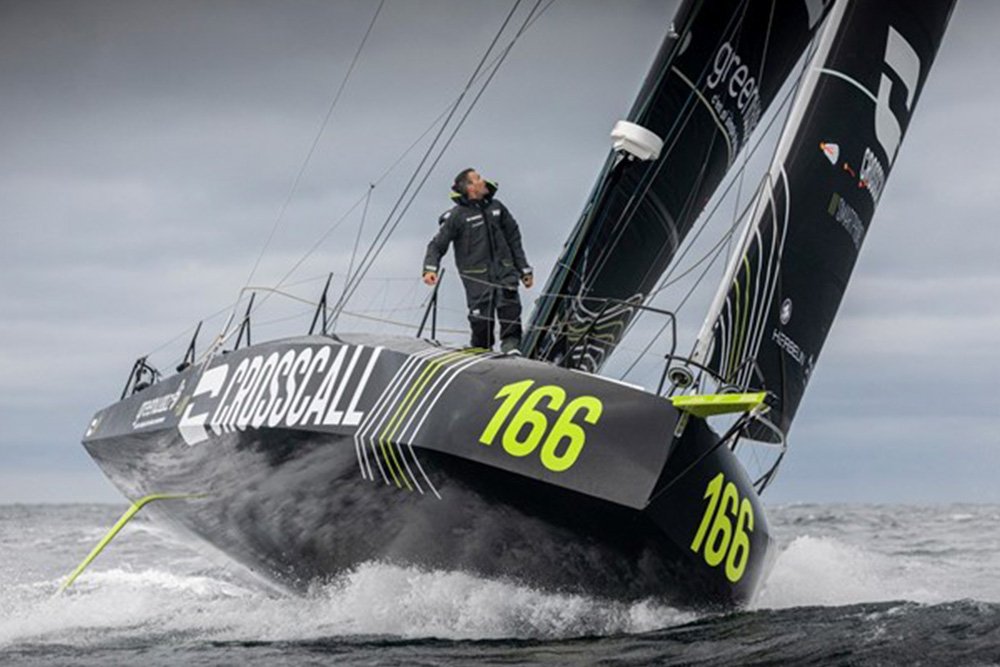
Grand Largue Composites (GLC, Mondeville, France) has introduced the world’s first flax fiber composite racing yacht. The yacht, called Crosscall, won the Class40 World Championships in June 2022 and is a prototype of the new Lift V2 design by Marc Lombard, one of the leading naval architects in this field.
Class 40 Yacht
Class40 is one of the most competitive fleets in yacht racing. The hulls of Class40 yachts must be lightweight, strong, stiff, and durable in extreme conditions. Furthermore, they cannot be reinforced with carbon fibers to keep costs down. Therefore, the quality and reliability of the resins used for the infusion and lamination of the hulls are of key importance. To make the design a reality, skilled infusion specialist, GLC, turned to its long-time material supplier, Sicomin. The hull was molded and infused in one piece, and the deck — including the hybrid flax fiber cockpit was also infused as a single part. The internal structure was then laminated into the hull by hand before the hull and deck were finally bonded together.
Flax is two to three times stronger than cotton, making it one of the strongest natural fibers. The flax plant species Linum usitatis- simum is made into linen fabrics, linseed oil, and even linoleum flooring. Flax fiber is obtained from the inner bark of the stem of a plant grown in temperate and subtropical regions of the world. Utilizing flax fibers in technical applications fulfills the required characteristics and is good for the environment.
The Materials Sicomin’s low-toxicity SR 8200 was used for laminating the internal structures onto the skin of the hull. Ideal for hand laminating, this system includes a choice of hardeners with a wide range of reactivities, which makes it equally suitable for making large or small parts. An epoxy bonding primer called Undercoat EP 215 HB+ and supplied by Sicomin’s sister company, Map Yachting — was applied to the molds first to make demolding easier. The infusion resin selected was Sicomin’s SR 1710, a high-modulus (HM) structural epoxy. Designed specifically for infusion and injection processes, it has ver low viscosity and its low-reactivity hardener makes it suitable for producing large parts.

