

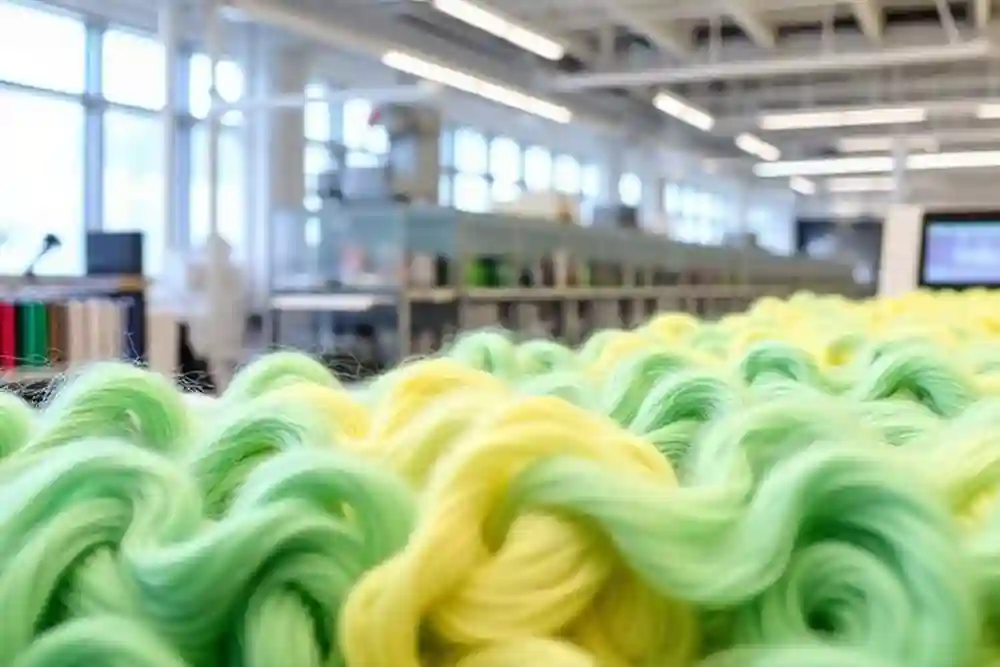
Just eight months after the foundation stone was laid, the DICE – Demonstration and Innovation Center for Textile Circular Economy was officially inaugurated at Thuringian Institute for Textile and Plastics Research in Rudolstadt.
The project represents TITK’s largest single investment to date, with a total cost of €11.5 million, of which €8 million was funded by the Free State of Thuringia through GRW and FTI programs.
What DICE Includes
- Four-storey laboratory and office building (~1,000 m²)
- Dedicated test hall (~1,000 m²)
- Biology and pulp laboratories
- Focus areas:
- Polyester recycling
- Cotton recycling
- Alternative pulp feedstocks
- A dedicated pulp cooking system (under construction in Saxony, operational in 2026)
Strategic Importance
According to Redlingshöfer, DICE is positioned to become a leading national and international center for:
- Environmentally friendly chemical pulp production
- Sustainable cellulose fiber development
- Advanced solution spinning technologies
The center directly addresses one of the textile industry’s hardest problems: recycling blended and mixed textiles at industrial scale.
From Research to Real Products
TITK has more than 30 years of experience in cellulose-based fibers, including advanced Lyocell developments using non-wood feedstocks such as hemp.
In 2025, the institute showcased the world’s first polo shirt made from triple-recycled hemp Lyocell (Lyohemp®) at the World Expo in Osaka, demonstrating real-world circularity beyond lab scale.
Beyond Apparel: Technical Textiles
DICE’s scope extends beyond fashion to high-performance technical textiles, including:
- Automotive
- Aerospace
- Defense
Here, regional closed-loop material cycles are positioned not only as a sustainability solution, but also as a resilience and industrial security factor.
Industry Backing
To date, 63 partners have committed to cooperation with DICE, including:
- Adidas
- Vaude
- Continental
- Head
Why This Matters
DICE marks a structural leap from textile sustainability concepts to industrial implementation. By combining recycling, fiber innovation, and spinning technologies under one roof, TITK and Thuringia are positioning themselves at the forefront of Europe’s textile circular economy transition—with implications for fashion, technical textiles, and industrial resilience alike.
Bottom Line:
DICE is not a pilot—it is infrastructure. And it signals that textile circularity in Europe is moving decisively from vision to scalable reality.

