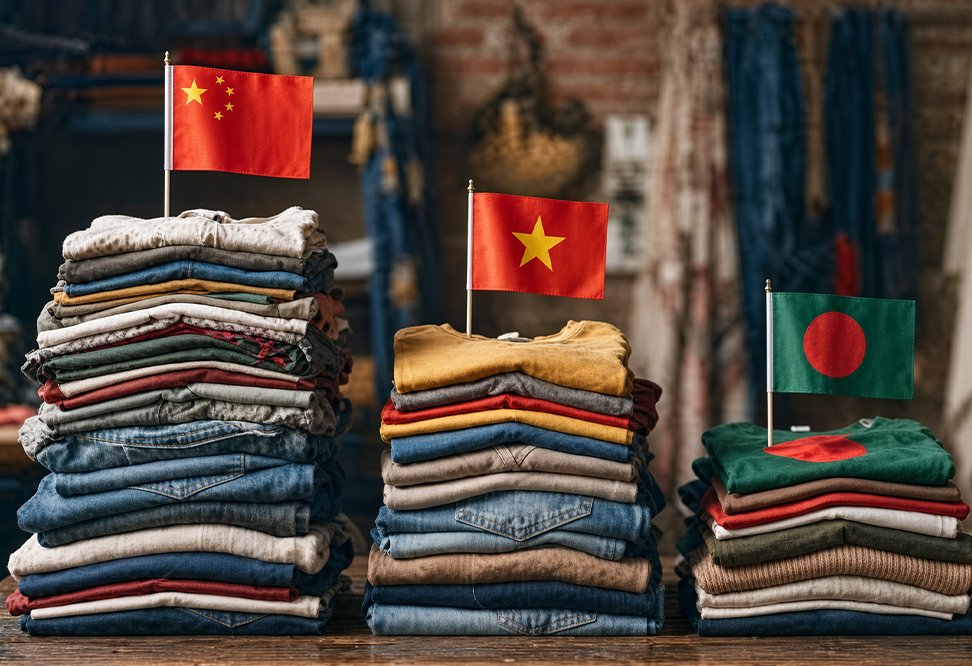
Garment exports have expanded sharply since 2006, but the bigger shift is competitive: Bangladesh and Vietnam have surged while synthetic fibres capture an increasing share of apparel growth.
Global trade in knitted and woven garments reached approximately $546.8 billion in 2025, up about 80% from $303.7 billion in 2006, according to the International Cotton Advisory Committee’s Textiles Observer.
Knitted-garment exports almost doubled from $145.2 billion to $289.1 billion, while woven garments increased from $158.5 billion to $257.7 billion. Together, the two categories represented nearly 60% of the $914 billion global textile export market in 2025.
Bangladesh and Vietnam gain ground
China remains the dominant textile and garment exporter, but the competitive hierarchy has changed substantially.
Bangladesh moved from 14th among textile exporters in 2006 to second in 2025, while Vietnam advanced from 21st to third. Combined with China, the three countries accounted for roughly 44% of global textile exports.
Demand is also becoming less concentrated. The United States remains the largest textile-importing market, but its share of global imports declined from 18.9% in 2006 to 13.7% in 2025, increasing the importance of European and Asian destinations.
Synthetic fibres capture more growth
The fibre mix is changing just as significantly. Cotton’s share of global fibre demand fell from 68.3% in 1960 to 21.1% in 2025, while synthetics rose from 4.6% to 71.7%.
Cotton-based knitted-garment exports still increased strongly—from $69.9 billion in 2006 to $128.3 billion in 2025—but their share of knitted apparel declined from 48.3% to 44.5%. Man-made and synthetic knitwear rose from $35.6 billion to $99.2 billion, lifting its share from 24.6% to 34.4%. In woven garments, synthetics and man-made fibres overtook cotton by value in 2021.
Competition moves beyond labour cost
The figures point to a more demanding sourcing market. Future gains will increasingly depend on man-made-fibre capability, productivity, speed, product development and diversified market access, not simply low labour costs.
For cotton-producing textile economies, the strategic challenge is particularly clear: capture more of a growing garment market while developing stronger synthetic and blended-product capabilities rather than relying predominantly on traditional cotton categories.