


Page 61 - April-May-2017
P. 61
61
Chemical approaches to crucial step in the circular textile chain. SaXcell
Reports cotton recycling well-defined waste stream. The sorting can be
production starts with sorting domestic cotton
textile waste into an as pure as possible,
done by hand as is customary now, or with the
Identitex (a technique still in development). Next,
the pure waste stream is grinded and non-textile
components like zippers, nails and buttons are
The global textile and apparel industry relies on a
with different fibre lengths. All fibre lengths, long
and short, are suitable as raw material for SaXcell.
production technique is considerably more
vulnerable, resource-intensive supply chain that from wood pulp) for decades, but the new removed. The result is a dry mixture of textile fibres
causes massive waste and environmental harm. It is environmentally friendly than the technique used for The dry mixture exists of different colours and is
one of the world's largest producers of toxic viscose, as no carbon disulphide is needed in the chemically decoloured and made suitable for the
environmental waste, affecting air, water, and soil dissolution process. In summary, dyes and other wet spinning process. Wet spinning can be done
resources. Over the past 20 years, recycling has contaminants are stripped from cotton textile according Viscose or Lyocell processes.
increasingly become an intrinsic part of our everyday garment waste. Next the cotton is pulped, breaking it
language. In the past, recycling clothing has usually down to its constituent fibre molecules. The new Cotton is widely used in the form of blends and
involved just “downcycling” it into something of fibres are produced from this dope by wet spinning. polyester is the most common choice. A simple
lower value. Jeans, for example, might end up as The extruded fibres can be engineered to custom process to separate polyester-cotton fabric blends
insulation in a building. Cotton is by far the world’s specifications, diameters, and cross-sectional into their individual components was developed at
most popular natural fibre, and much of it is used for shapes. Compared to virgin cotton, the new Deakin University. By using an ionic liquid (salt in a
clothing. No doubt, it would be ideal if all those technique also reduces the water footprint by more liquid state), the Deakin researchers first dissolve
cotton clothes could simply be recycled into new than 70% and the carbon footprint by 40–50%. the cotton component, regenerate the dissolved
garments when their time was up. It would keep cotton into fibres and recycle the salt solution back
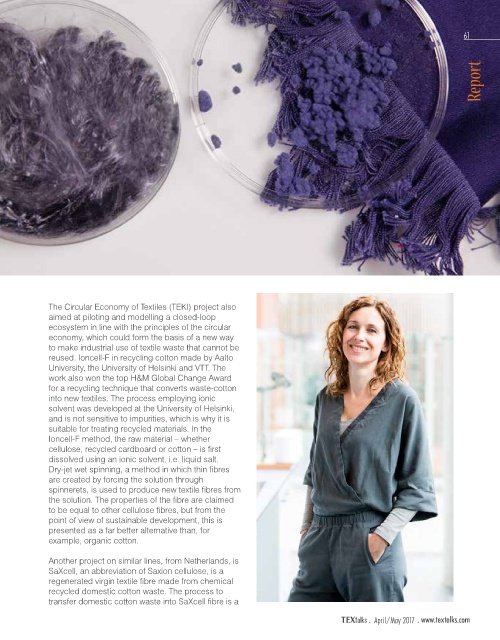
millions of tons of waste out of landfills, and allow This subject has recently gained a lot of interest The Circular Economy of Textiles (TEKI) project also into the process. The remaining polyester fibres
the fashion industry to use far less virgin material, in worldwide and few examples are shared. Evrnu aimed at piloting and modelling a closed-loop can be melted and reshaped into fibres or
turn cutting use of water, pesticides, and chemicals (evernew) purifies cotton garment waste, converts it ecosystem in line with the principles of the circular plastics. Ionic liquids are an environmentally
for dyeing. to a pulp, and extrudes it as a pristine new fibre for economy, which could form the basis of a new way friendly solvent, unlike other chemical solutions
the creation of premium textiles. It is claimed to be to make industrial use of textile waste that cannot be commonly used to dissolve polyester.
Unfortunately, recycling cotton clothes isn’t simple. finer than silk and stronger than cotton. Evrnu reused. Ioncell-F in recycling cotton made by Aalto
To create a new piece of clothing from old clothes, claims that this upgrade to beautiful clothing is with University, the University of Helsinki and VTT. The Lenzing launched a new TENCEL® fibre made
the old clothes first have to be chopped up and significantly less environmental impact compared to work also won the top H&M Global Change Award from cotton waste fabrics to drive ‘circular
turned back into raw material. But that chopping-up our best alternatives and it is the first invention of its for a recycling technique that converts waste-cotton economy’ solutions in the textile industry. The new
process tends to lower the cotton’s quality because kind to be commercialized in the U.S. into new textiles. The process employing ionic generation of lyocell fibre is claimed to be the
it shortens the staple length of the fibres. Staple solvent was developed at the University of Helsinki, most ecological wood-based fibre on the planet –
length plays an important role in determining the and is not sensitive to impurities, which is why it is combining cotton waste recycling with Lenzing’s
strength and softness of cotton threads. The longer suitable for treating recycled materials. In the pioneering closed-loop TENCEL® production on a
the staple, the better these characteristics, which is Ioncell-F method, the raw material – whether commercial scale. Tencel has already been
why cotton varieties with extra-long staple lengths, cellulose, recycled cardboard or cotton – is first awarded the EU award for the most eco-friendly
such as Supima, are highly valued—and why fashion dissolved using an ionic solvent, i.e. liquid salt. production process based on 99.7% closed loop
brands currently find it difficult to use any large Dry-jet wet spinning, a method in which thin fibres circulation in the production and use of bio-energy.
amount of recycled cotton in their products. The are created by forcing the solution through Lenzing is the first manufacturer worldwide to offer
mechanical recycling (downcycling) of cotton fibres spinnerets, is used to produce new textile fibres from such cellulose fibres incorporating recycled
is well established and recently there has been a lot the solution. The properties of the fibre are claimed materials on a commercial scale. The latest
of interest in chemical recycling of cotton. The By changing the idea from just shredding up the to be equal to other cellulose fibres, but from the next-generation TENCEL® fibre combines two
technological details of the chemical process are garments to actually kind of melting them, point of view of sustainable development, this is aspects - recycling cotton waste fabrics and using
generally of proprietary nature. dissolving them down to their molecular structure presented as a far better alternative than, for the most sustainable TENCEL® technology - to
of cellulose, and reconstituting the fibre, it example, organic cotton. create one of the most ecological wood-based
Cotton that is not suitable for reuse can be dissolved eliminates the pollutants and re-extrusion to a fibres on the planet. The recycling of cotton waste
to make cellulose solution, which can be turned into continuous filament fibre, it has improved Another project on similar lines, from Netherlands, is fabrics into virgin textile TENCEL® fibres can offer
new fibre. Cellulose fibre can be produced using the strength quality. Evrnu partnered with Levi’s to SaXcell, an abbreviation of Saxion cellulose, is a a practical solution to enable circular economy in
same technique and equipment as has been used to produce a pair of denim which included Evrnu regenerated virgin textile fibre made from chemical the apparel industry.
make viscose fibre (regenerated cellulosic fibres for weft yarn. recycled domestic cotton waste. The process to
transfer domestic cotton waste into SaXcell fibre is a

